An Image of Multi-tasking Womanhood

By The Curious Scribbler

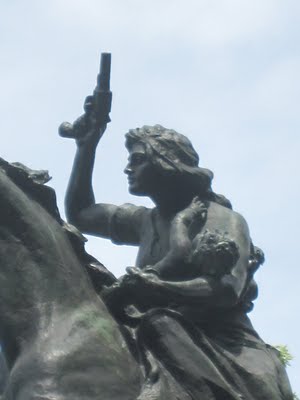
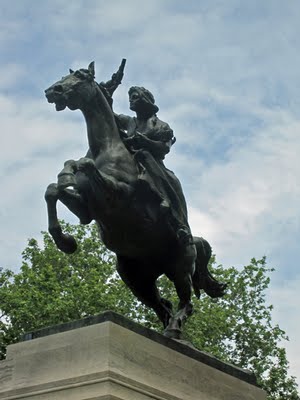
Cruising the works of Italian sculptor Mario Rutelli, I came across another work of his, the memorial to Anita Garibaldi on the Juniculum Hill in Rome, which was created in 1931.

If ever we need a monument to multi-tasking this must surely be it.  Poised upon a rearing steed, brandishing a pistol whilst breastfeeding her infant son, the Brazilian wife of Guiseppe Garibaldi is represented as a heroine of mythic proportions. Fashioned 83 years after her death, to embellish the seventh and final resting place of her mortal remains, there is no reason to consider this an accurate portrayal of the woman, but of an ideal.

Rutelli’s Anita is the stuff of legends – mounted on a rearing horse (an exceptional feat of engineering) she brandishes a pistol in one hand while holding her nursing son close in the other arm. Photo: Will Hobbs

Garibaldi was an active Republican dedicated to the liberation and unification of Italy.  Finding it politic to depart for South America, he soon became involved in fighting for  independence in Brazil.  During this swashbuckling existence he acquired an 18 year old  Brazilian wife, Ana Maria de Jesus Ribeiro, who often fought at his side, dressed as a man, and is credited with greatly improving his horsemanship. During a five year lull in revolutionary activity in Montevideo he worked as a schoolteacher and fathered four children with her.

He and his family returned to Italy to join the conflict between the revolutionary army and the invading forces of Napoleon III.  Briefly the revolutionary army won the battle of the Juniculum Hill in 1849 and repelled the French.  However two months later the Roman Republic was defeated, and he and Anita were fugitives.  Four months pregnant with their fifth child and ill with malaria, Anita died, at a farmhouse near Ravenna, in her husband’s arms, and was hurriedly buried in an unmarked grave.  She was just short of her 29th birthday.

Monument to Ana Maria de Jesus Ribeiro di Garibaldi, best known as Anita Garibaldi, on the Juniculum Hill, Rome.  Photo Will Hobbs

Oddly, when I studied History O level many years ago, the examiners had determined that we should study this period of Italian history.  So I used to know quite a lot about Count Cavour, Victor Emmanuel II, Mazzini, and Garibaldi.  At  an age when I had learnt  almost nothing about 19th century British history it seemed an irrelevant and isolated bit of knowledge, most of which I promptly forgot.

However everything forms connections eventually.  And the connection with Aberystwyth?  Well, it confirms my suspicion that the sculptor Mario Rutelli was in his element with an imaginative brief, and his female figures are rarely sedate in their bearing.  By contrast how bored must he have been with his commission for the bronze full figure sculpture of Edward Prince of Wales ( Edward VIII) in the robes of Chancellor of the University College of Wales in 1922.  It too survives, seldom remarked upon, in the narrow strip between the Old College and the sea.

I am grateful for permisison to reproduce the photographs of Anita’s monument, see http://willyorwonthe.blogspot.co.uk/2011/06/beside-every-great-man.html


Truth comes out of the Bushes

by The Curious Scribbler

Just occasionally, life imitates fiction with the well-turned symmetry of a good short story.

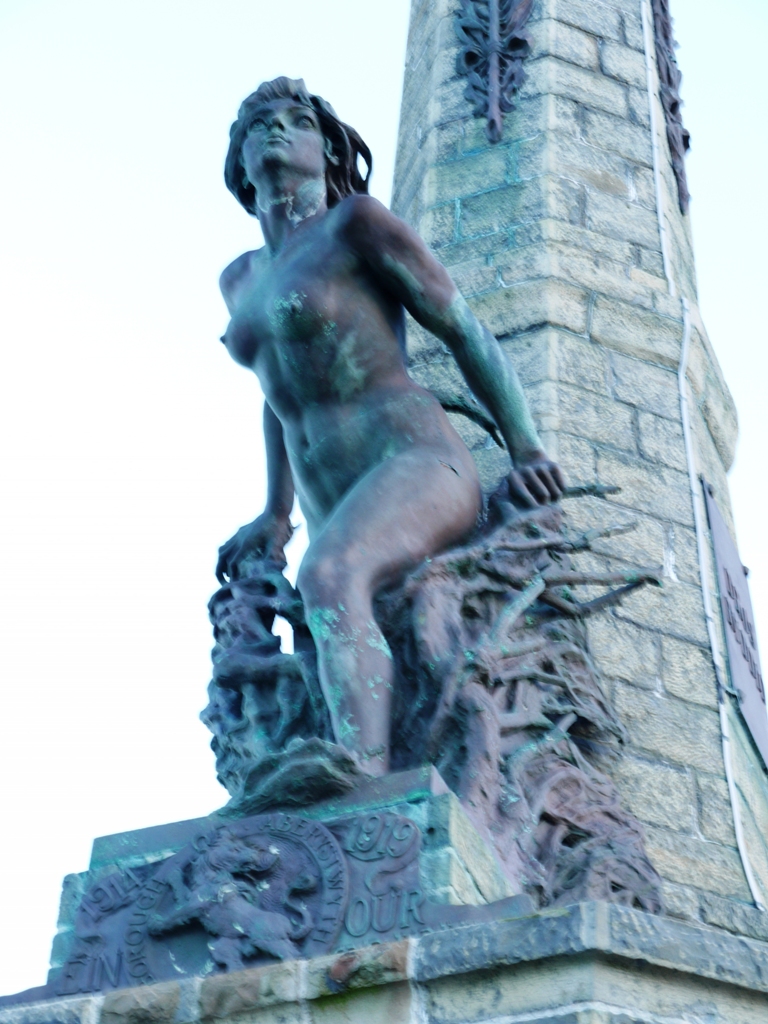
When I started writing about the Aberystwyth’s war memorial I drew only upon my own imagination in describing the striking nude at the foot of the column as “a naked woman emerging from a thicket”.

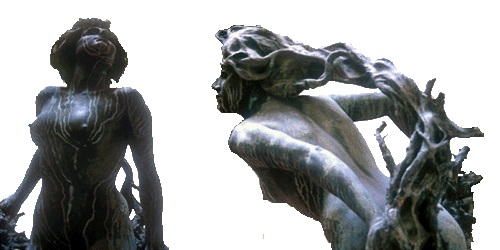
Since then I have searched the internet for similar images using various search engines and search terms, and at last my quest bore results, in the form of pictures on the website of a professional conservationist and restorer in Rome.  Here was the self same girl! http://www.art-conservation.it/rutelli.html

Two views of Rutelli’s sculpture  “Verità esce dai Rovi” which stands in a courtyard in Rome. Photo: Marco Demmelbauer, before restoration

Marco Demmelbauer  tells me that he worked on this Rutelli sculpture many years ago. It is privately owned and can be seen in the courtyard of an apartment block, at Via Quattro Fontane n.18  in Rome.  The sculpture has a name too!  Not quite “Humanity emerging from the Horrors of War”, but  “Verità esce dai rovi”,   which translates as “Truth comes out of the bushes”.  I feel vindicated indeed!

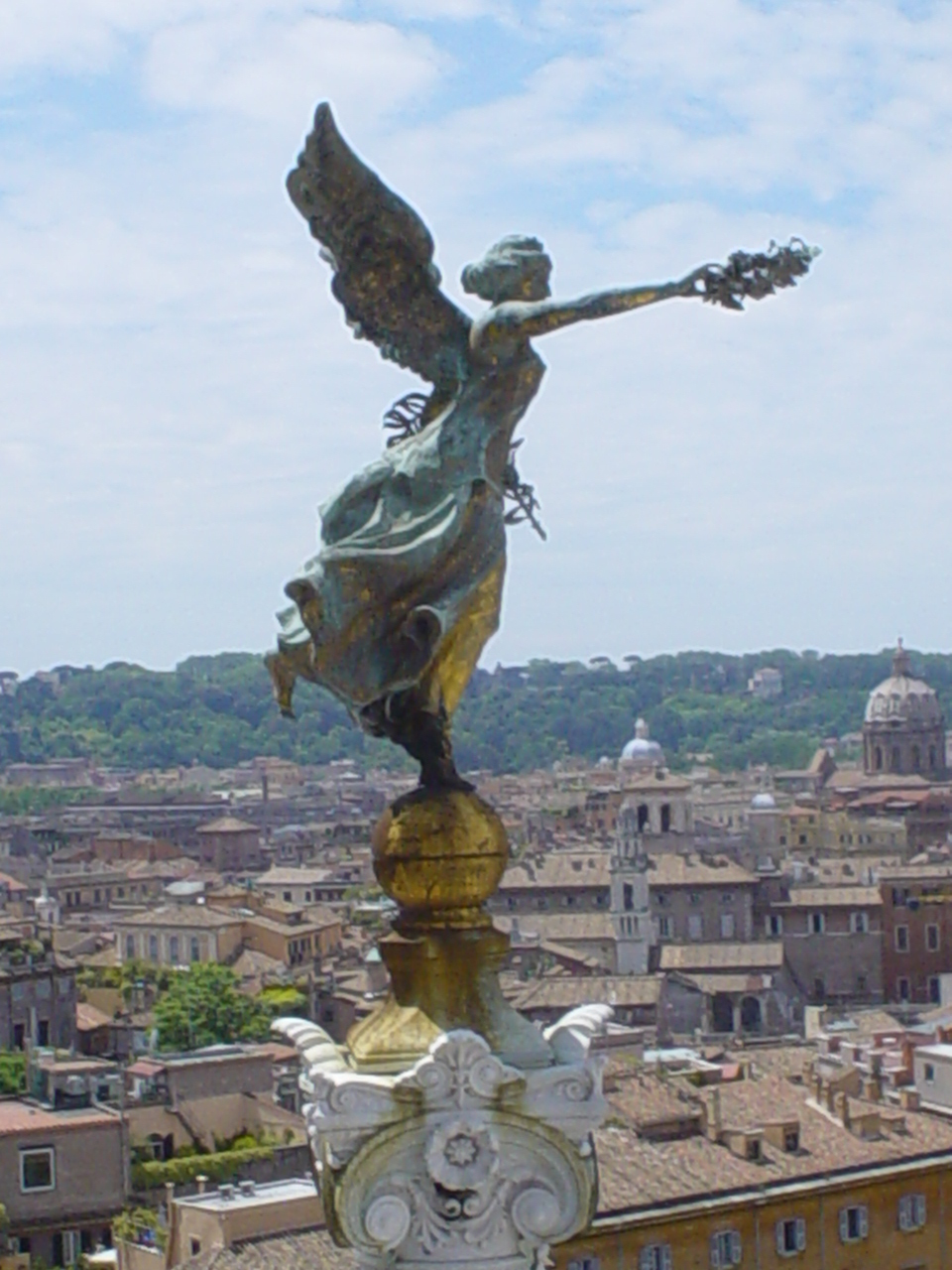
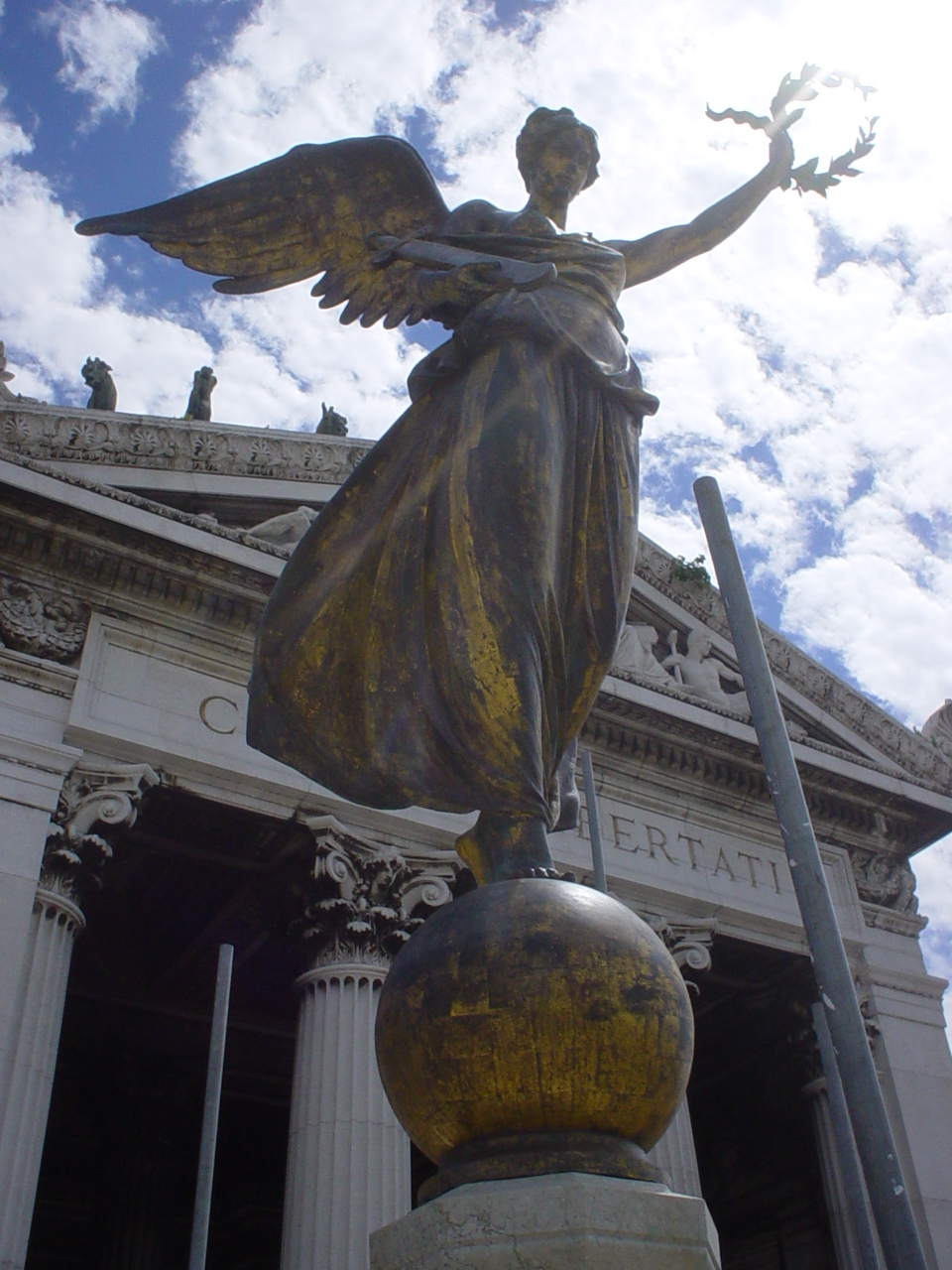
It now seems clear that our Aberystwyth war memorial sculptures are from re-used moulds, and have elder sisters elsewhere in Europe.   In my last blog I pointed out that the Winged Victory by Rutelli on top of our memorial had already been poised on a monument in Palermo since 1911.  I am grateful to Marco Demmelbauer for pointing out that she also stands on the right hand column in front of the Monumento Nazionale a Vittorio Emanuele II in  Rome.  This also dates from 1911.

The same Winged vistory as we have in Aberystwyth

Winged Victory by Rutelli on a column in front of the Monument to Vittorio Emanuele II in Rome
Photo: Marco Demmelbauer

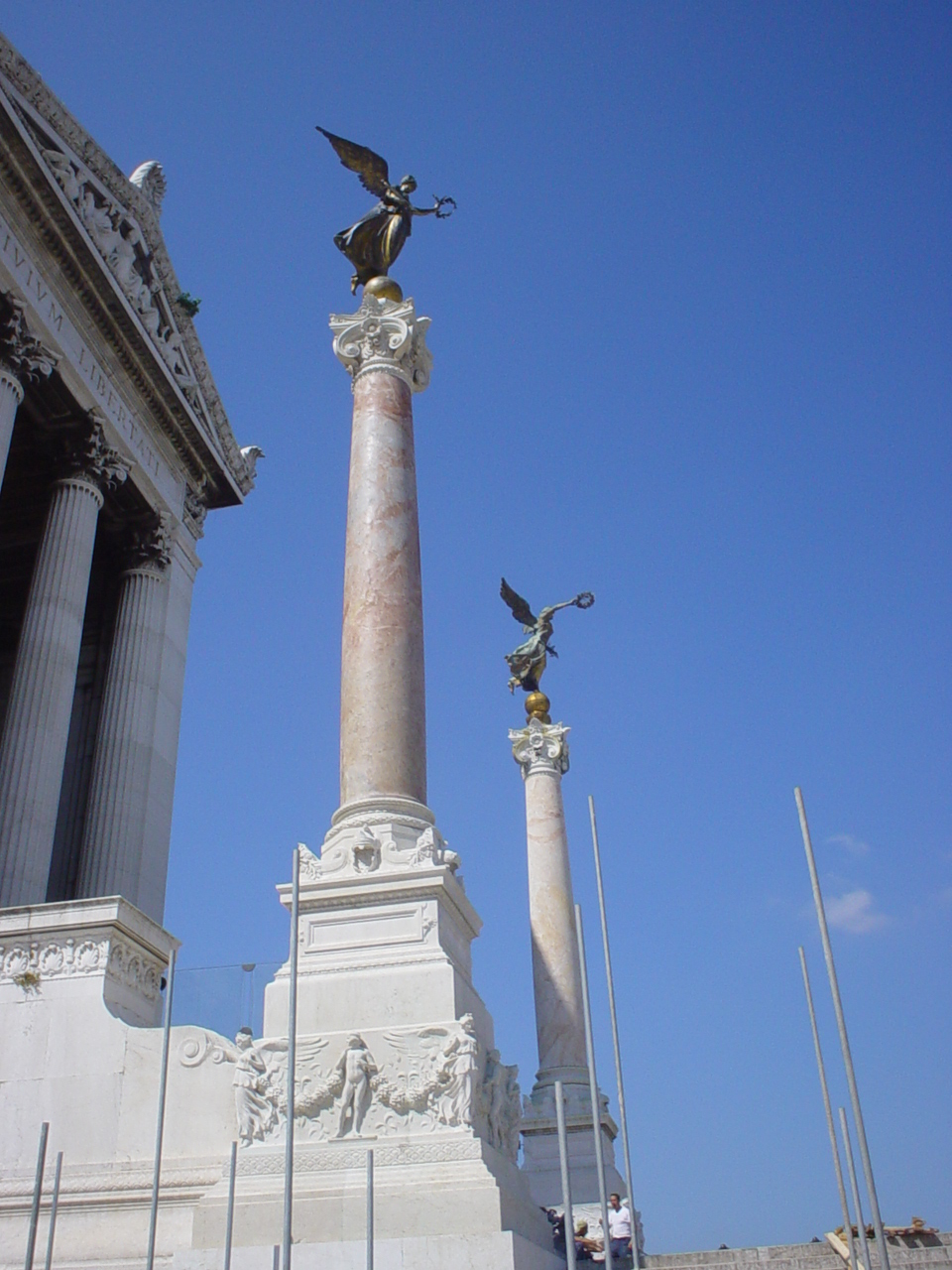
Winged Victories were not however the sole preserve of a single artist.  The original Victory ( the Goddess Nike) was discovered in 1863 in Samothrace, and is one of the great treasures of the Louvre.  She was fashioned in Parian marble about 190 BC.  A few extra fragments of her, the right hand, a finger tip and thumb have turned up, but her arms and head being missing has left scope for the re-interpretation of the figure in the late 19th and 20th centuries.  Rather remarkably the two tall Roman columns bear two different Winged Victories, one by Mario Rutelli and the other by another sculptor Arnoldo Zocchi.

Winged Victory by Zocchi on the other column in front of the Monument to Vittorio Emanuele II in Rome.
Photo: Marco Demmelbauer

It seems that there were certain criteria for these turn-of-the-century Nikes.   Unlike Truth/Humanity, a Winged Victory is modest, her long draperies rippling in a strong breeze, and she holds aloft the laurel wreath of victory.  She stands upon a sphere, and carries some kind of object in her other hand. Here the interpretations vary, Zocchi provides a sheathed weapon, Rutelli some kind of foliage.

Winged Victories by Rutelli and by Zocchi on columns in front of the Monumento Nazionale a Vittorio Emanuele II in Rome.
Photo: Marco Demmelbauer

Exactly whose influence led to Rutelli tendering a design for a war memorial  utilising two of his pre-existing works for the Borough of Aberystwyth has yet to be revealed, but my guess is that Lord Ystwyth had a good deal to do with it.


More on the memorial

by The Curious Scribbler

A number of readers of my last blog have commented that 1923 is not especially tardy for the erection of a war memorial. The Royal Artillery memorial by CS Jagger in Hyde Park was not unveiled until 1925, and my fellow historical  blogger in the Essex village of Great Dunmow reports that their much less elaborate memorial was unveiled in 1921.http://www.essexvoicespast.com/war-and-remembrance-the-making-of-a-war-memorial/

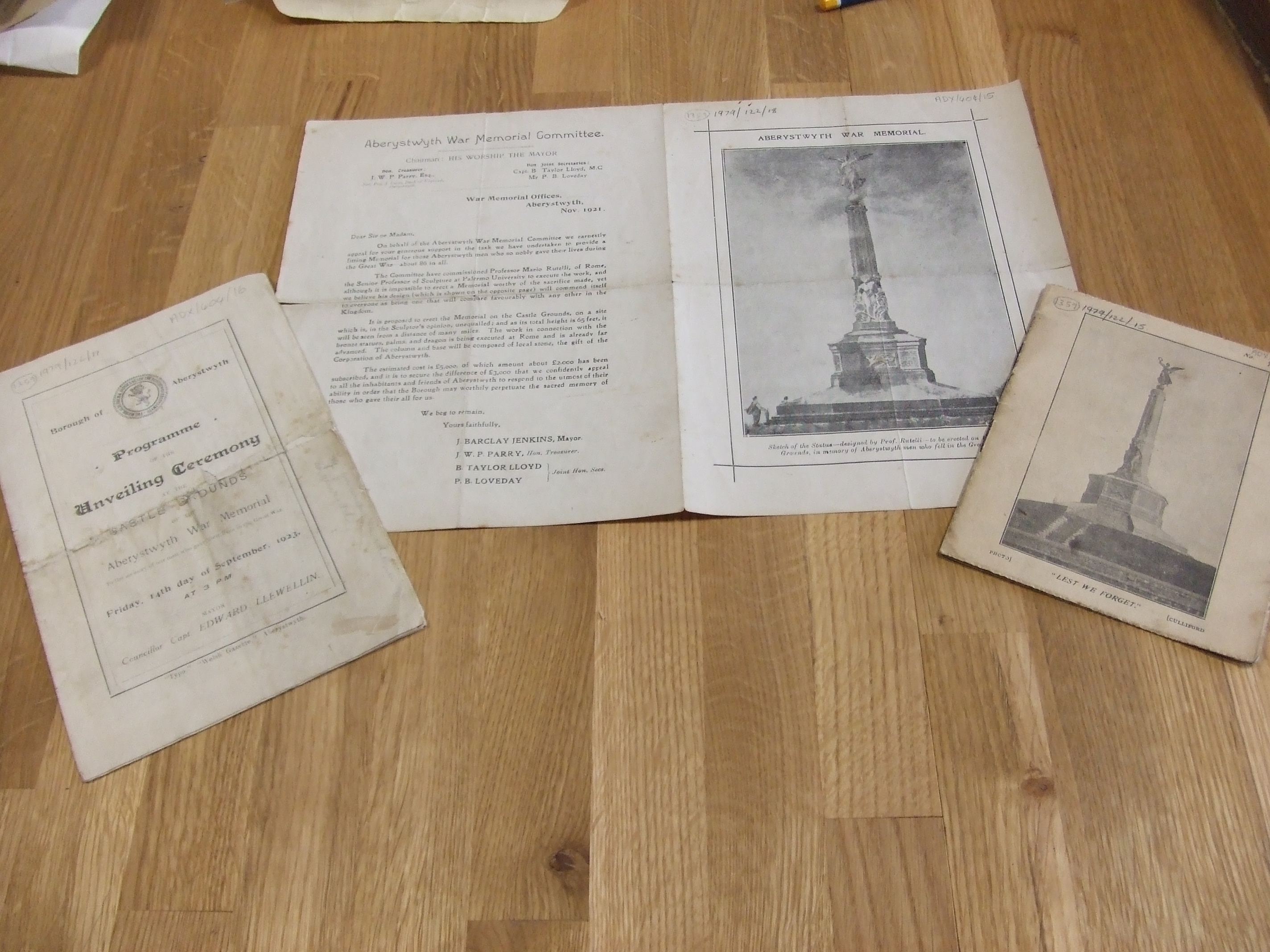
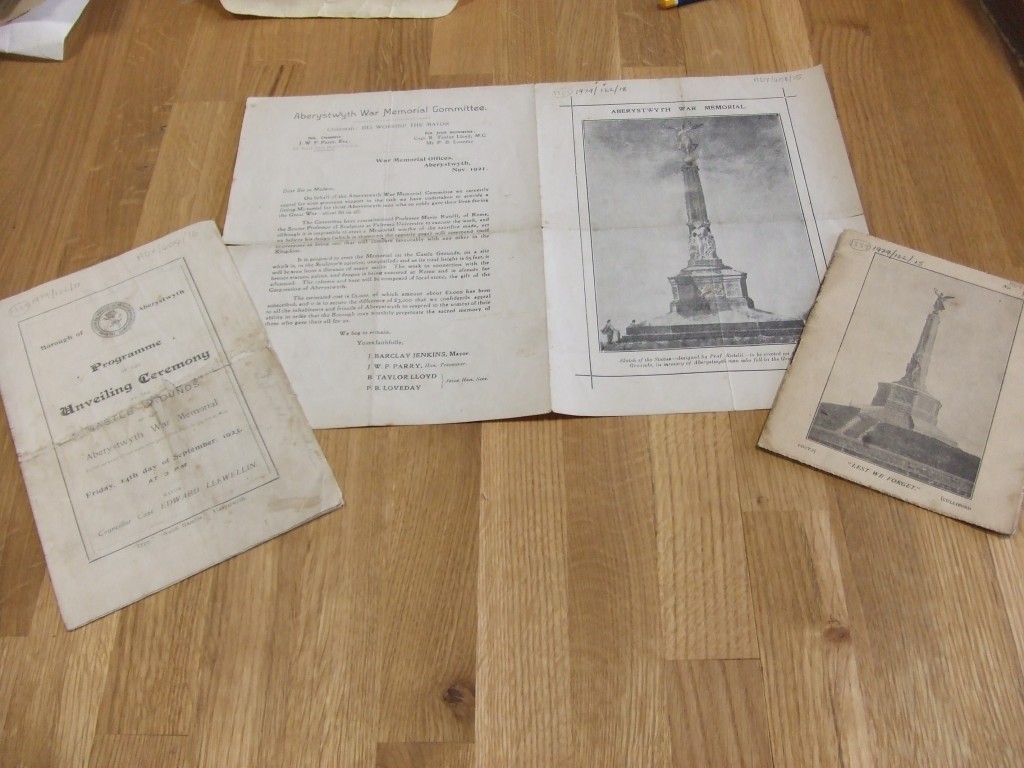
In search of more background I spent a pleasant hour in the Ceredigion Archives http://archifdy-ceredigion.org.uk/  which afforded me the joy of inhaling the fragrance of a bound volume of 52 issues of the Cambrian News for 1923.  An experience far more evocative than scrutinising the screen of a microfiche reader.  Also, an envelope of world war I Aberystwyth miscellanea revealed several choice ephemera: an estimate and appeal for funds from the War Memorial Committee in 1921, the programme for a three day fund raising bazaar in 1923, and the programme of the actual unveiling ceremony held on Friday 14 September 1923.   I also had a trawl round the internet.
DSCF0786

The war memorial committee handbill, flanked by the programmmes for the three day bazaar and the unveiling on 14 September 1923

The War Memorial Committee, put out a hand bill in November 1921 with an artist’s impression of the Rutelli monument.  It informs the reader that “the bronze statues, palms and dragon is being executed at Rome and is already far advanced”, while the “65 foot column and base will be composed of local stone, a gift of the Corporation of Aberystwyth”.  Actually some or all of the bronze statuary may have pre- existed the commission.  A trawl of the internet finds the identical twin of our Winged Victory in the Piazza Vittorio Veneto in Palermo, on a column designed by Ernesto Basile, erected to commemorate the unification of Sicily and Italy. It was unveiled in 1911.  She balances on the same ball as Aberystwyth’s figure, but is sited on a more ornately carved 28 metre plinth.
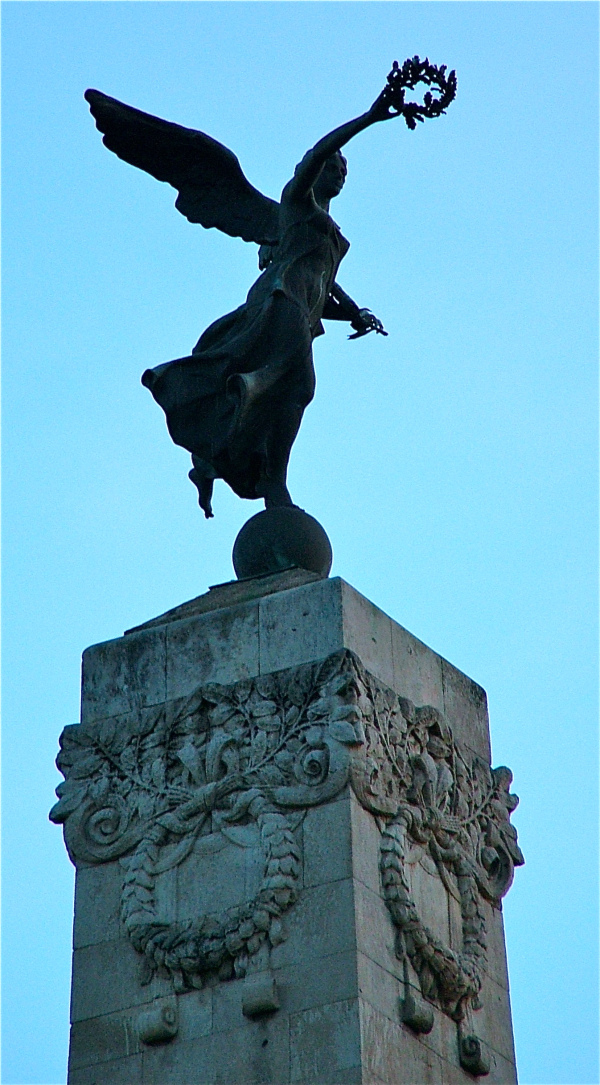
Victory by Mario Rutelli, on the monumento ai Caduti in palermo

The monument at the end of the Piazza Vittorio Veneto was designed by Ernesto Basile, to commemorate the unification of Sicily and Italy. After world war I,  Victory, by Mario Rutelli was set upon the the top.
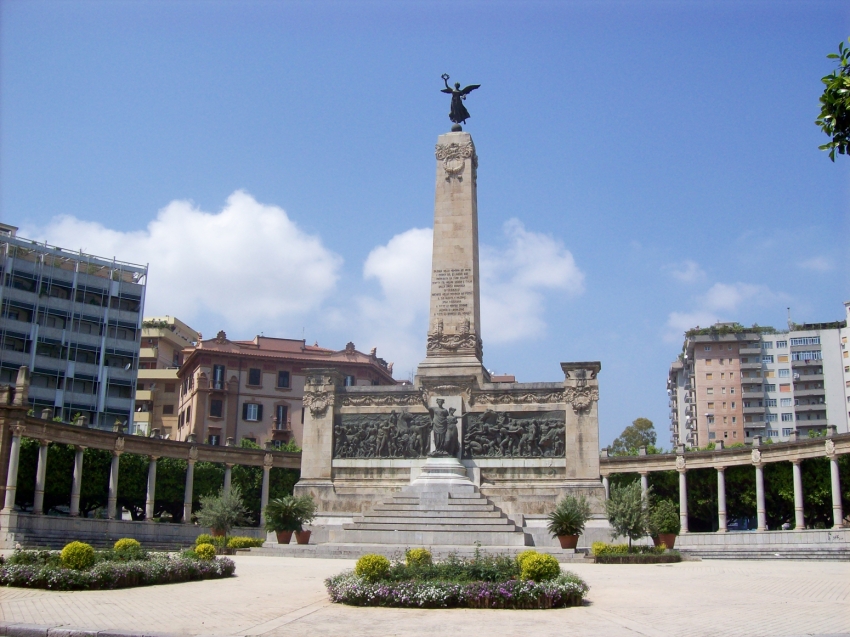
The winged Victory in Palermo

The Piazza Vittorio Veneto, Palermo
http://palermo.eventseekr.com/war-monument/tourist-attractions-sightseeing/venue/653011

Rutelli’s Winged Victory for Aberystwyth must have been a later commission, years after Palermo’s monument was updated.This sets one thinking about our buxom Aberystwyth wench, Humanity emerging from the Horrors of War.
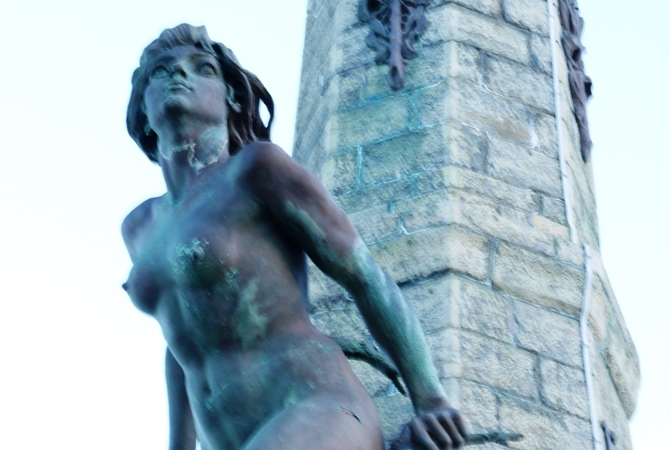
Humanity emerging from the Horrors of War, Aberystwyth

She bears a close resemblance to the girls who can be found wrestling with sundry water monsters in Rutelli’s Fountain of the Naiads in the Piazza della Republica, Rome.  When these four figures were installed in 1902 their realism and saucy image created a considerable storm.  Representing the oceans, the rivers, the lakes  and the underground waters each embraced an allegorical animal: horse, snake, swan, and strangely finned fish and they were felt to be doing so with excessive languor and or enthusiasm.The guide books assert than an additional challenge to the public morals of Rome was that the naiads were modelled upon twin sisters, high price Roman prostitutes of the day.  A fence was erected around the fountain to curtail the view from ladies who might be offended, or prevent incursions by lewd young men.
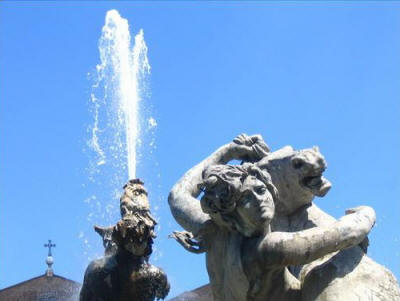
Fontana delle Naiadi, The Naiad of the Oceans –                                                                                    Photo © Benedetto Dell’Ariccia

Compare the faces of the Naiad of the Oceans, the reclining naiaid of underground waters and of Aberystwyth’s Humanity.  I suspect she is one and the same girl.
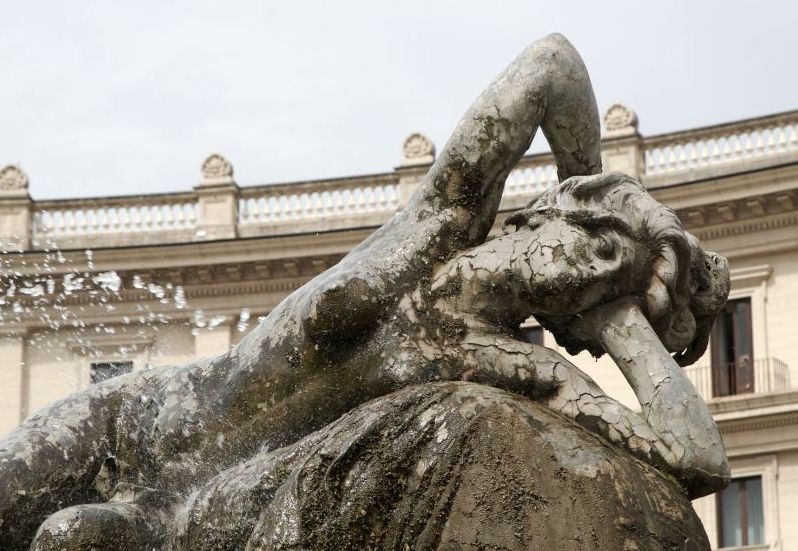
Naiad of the underground waters Photographed by Massimo Merlini
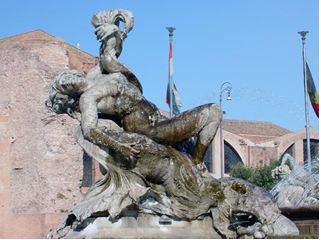
River naiad by Rutelli, in an abandoned pose

To return, though to the Aberystwyth documents:

On their handbill in November 1921 the War Memorial Committee stated that the estimate for the memorial was £5,000 of which £2,000 had been subscribed so far. The rest was slow in coming in.

The Cambrian News of 1923 shows feverish fundraising activity – for the monument was nearing completion and more than £2600 had still to be raised.  In spring there were a series of Fund-raising teas given by members of the local gentry, – in March Lord Ystwyth’s tea raised £4-14-0d, and a week later John Williams’ tea raised £4-10-0d.  But much more money was needed.

Alderman J Barclay Jenkins had, in his then capacity as mayor of Aberystwyth, cut had the first sod on the castle ground in January 1922, and remained chairman of the Memorial Committee. When the new mayor, Councillor Captain Edward Llewellin took on the post the following November he remarked that  “he was taking on a job” and would have to do his share to clear the deficit, “ for the memorial was there now, and the debt had to be cleared”.

The solution was the Three-day bazaar, held in the College Buildings, the former railway hotel which had become the home of the University College of Wales, Aberystwyth.  Lord Ystwyth, a founder of the College, presided. Daily it was opened by a different local dignitary, ( from each of whom tradition would have required a substantial donation) and the townswomen strove mightily with stalls devoted to cakes, needlework, handicrafts, knitting, flowers, and games including Finger Football. By close of business on Friday 14th September, the bazaar had raised £2,300, and with a small shortfall the unveiling took place the same day with a printed programme to mark the event. Hymns were sung in both Welsh and English.

The Cambrian News reported the facts and figures the following Friday.  One hundred and eleven names from the Borough appear on the plaques. Lord Ystwyth, “aged though sprightly, slowly mounted the steps to pay tribute to our glorious dead”.  The Cambrian News, though thorough in its reporting, expresses no opinion on the monument itself, confining itself to a series of facts and figures: the total cost of the monument had been over £7000, the 65 foot column was of stone from Ystrad Meurig Quarry, the palm leaves on its shaft each 13 foot long.  The figure of Ball and Victory was 15 foot tall, and the figure at the base 14 foot high.  No adjectives at all encompass the description.

The Italian sculptor Rutelli did not attend.  I wonder whether Humanity was actually a refugee from a pre-war ornamental commission, possibly one as a naiad?   If so, her creator may not have wished to be present to fully justify her re-assignment to so much less frivolous a purpose.


Aberystwyth’s raunchy war memorial

by The Curious Scribbler

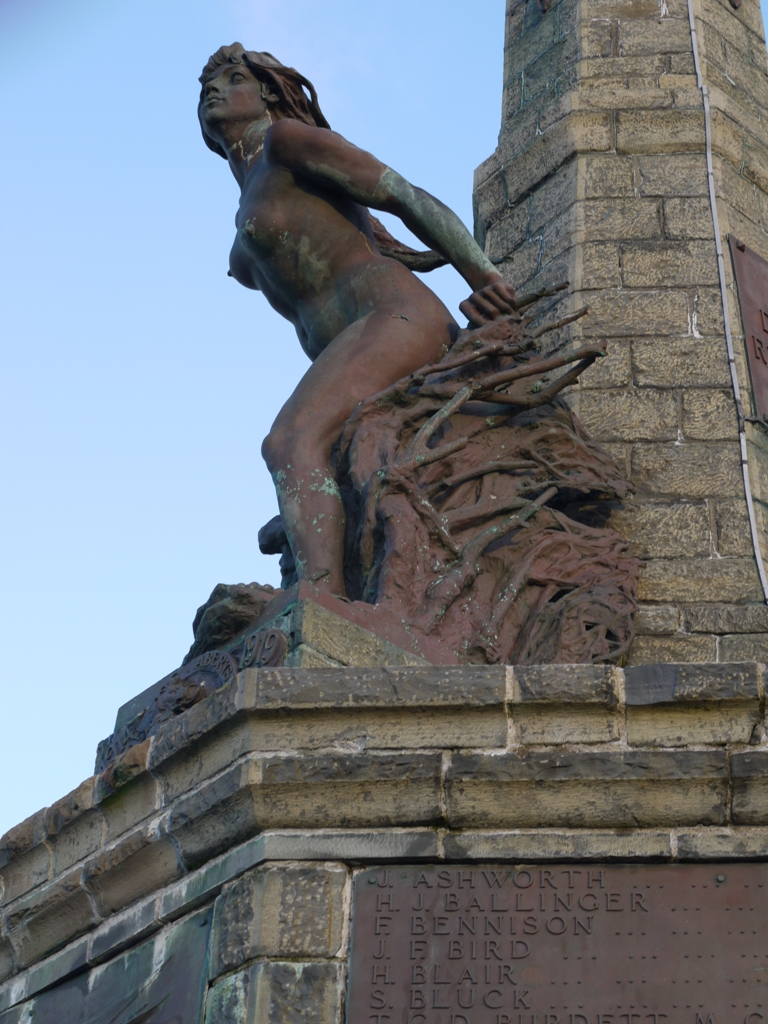
There is a very chilly naked woman emerging from a thicket on the sea front at Aberystwyth.   She faces the sea, in the teeth of every westerly gale, on the margin of the ground once occupied by the Norman castle.  She is, to say the least, a well built girl, larger than life and fashioned in bronze.  No wispy maiden she, but a flesh and blood woman with strong thighs, pert, full breasts, large capable hands and a purposeful expression.

P1050185sm

The bronze figure at the base of Aberystwyth war memorial


As the authors of the recent Pevsner sedately remark, “ Unexpectedly sensual for a Non-conformist country”.

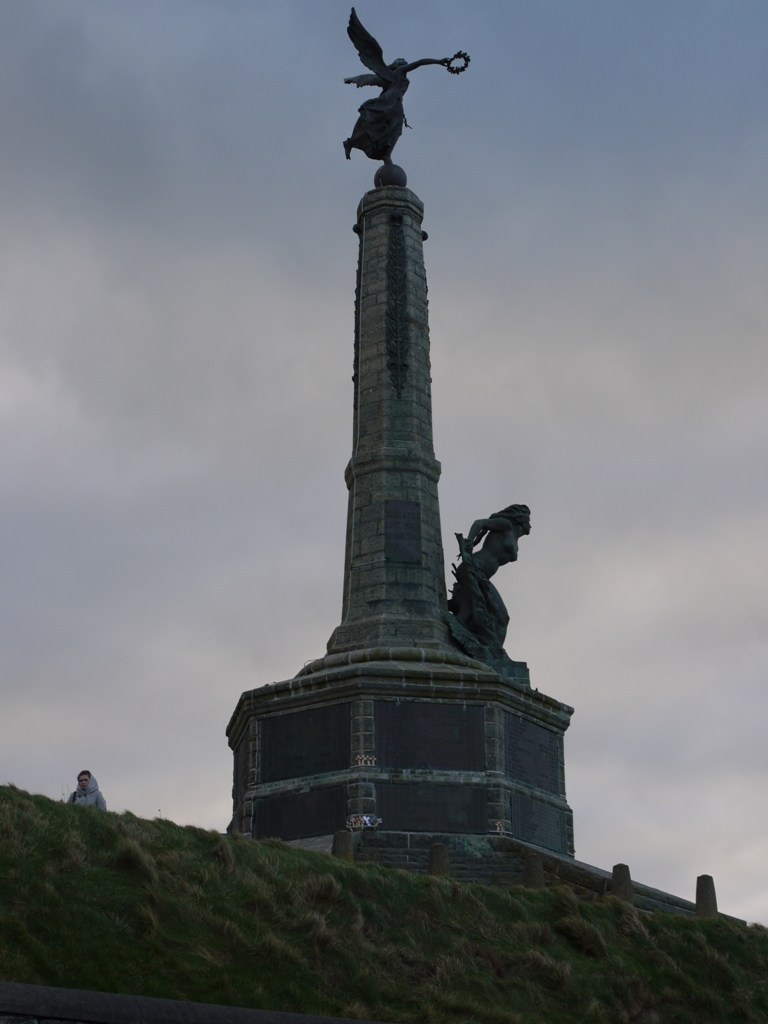
For this huge empowered woman is the lower ornament on the Aberystwyth War Memorial, erected to commemorate the dead of the First World War.  Rising from her octagonal plinth is a  tapered shaft of stone, and on top of it a pretty, rather fey angel with billowing dress and an elegant pair of wings.  She appears to be about to lob a wreath of laurel, hoop-la style, onto the head of her companion below.

P1050180sm

The Winged Victory atop the column throws a wreath of laurel


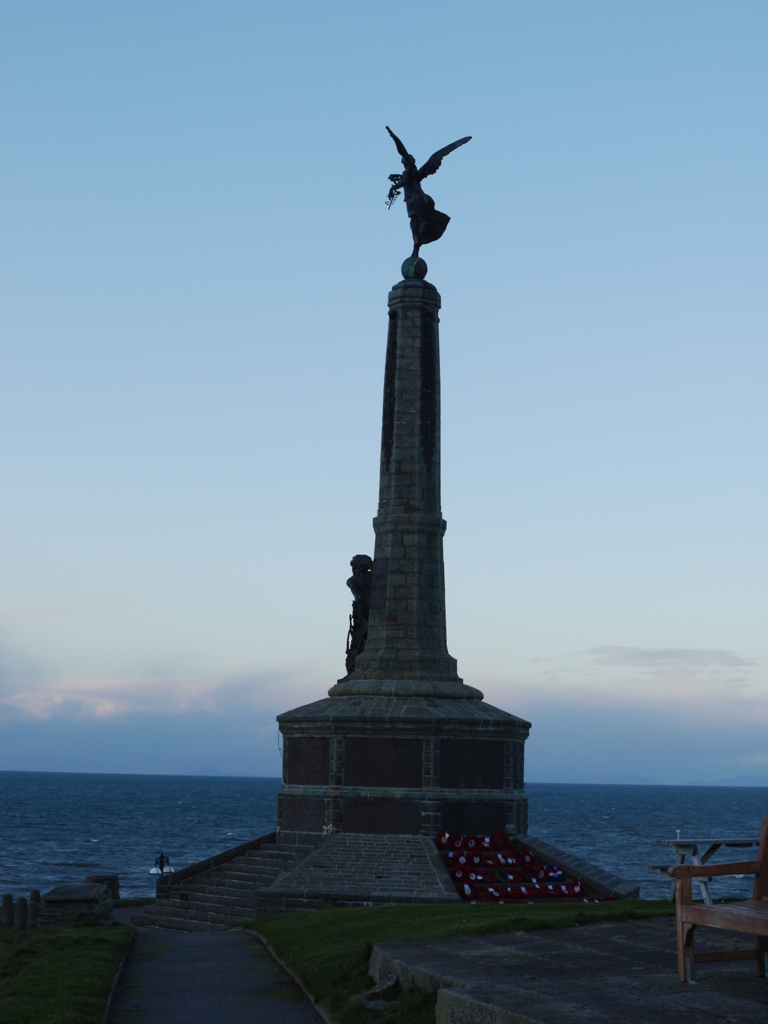
The memorial is the work of an Italian sculptor, Mario Rutelli, and was erected fairly long after the close of war, in 1923.  The angel above is, apparently, the Winged Victory, whilst the powerful nude represents Humanity emerging from the Horrors of War.  The bronze thicket from which she strains to escape is thought by some to be seaweed, by others to be rifles transmuted back into bushes.

Later tablets on the plinth commemorate the Aberystwyth dead of the Second World War, and the monument is the final destination of the Poppy day parade.

P1050224sm

The memorial stands in the full blast of the westerlies off Cardigan Bay

P1050172sm

The memorial stands in the full blast of the westerlies off Cardigan Bay

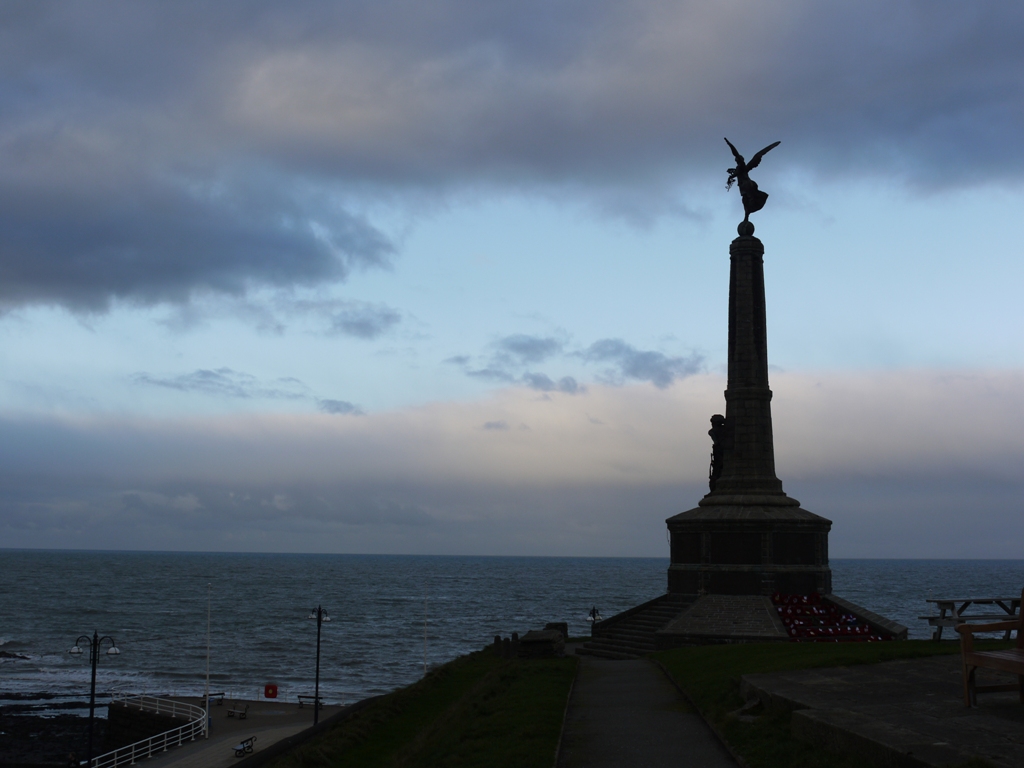
The winter sun goes down over Cardigan Bay

The winter sun goes down over Cardigan Bay

This western extremity of the headland north of the harbour is a place of great beauty, commanding views along the coast southward to the sharply truncated cliff of Alltwen.   Framed by woodland a little inland from the sea squats a grey stone mansion, recently released by its new owner from a dense surrounding of self-seeded sycamore and ash.  This was the home of Matthew Lewis Vaughan Davies, later Lord Ystwyth, Liberal MP for Aberystwyth from 1895 to 1921.  Lord Ystwyth was a bit of a philanderer in his life and died at the great age of 94.   Posthumously, historians have judged him harshly.  However he was undoubtedly a mover and shaker in his time, founder among other organisations, of the Royal Welsh Agricultural Show, and in 1923 he was made Honorary Freeman of the Borough of Aberystwyth.  It appears that it was his influence which provided his home town with what is surely the least sombre war memorial in the land.

War memorial sculpture by Mario Rutelli

A handsome girl, Humanity emerging from the Horrors of War, Aberystwyth

Twelfth Night

by The Curious Scribbler

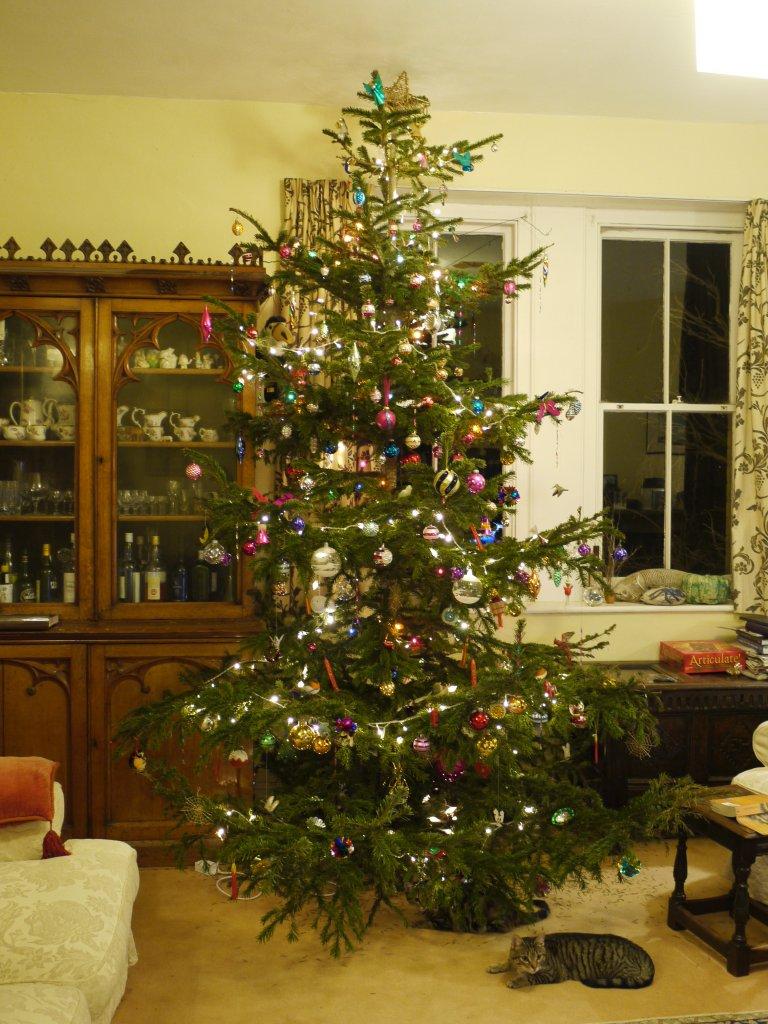
We took down the Christmas tree today.

The tree bears witness to six decades of decoration styles

It seems there is a certain amount of debate as to when you start counting the nights of Christmas and when the children were small we usually took it down on the 6th, Epiphany. No serious bad luck attended this oversight I’m glad to say.  Now there is a wealth of advice on the web which explains that Twelfth Night is really the 5th of January, though an exception is often made for decorations featuring the crib, since the wise men are not scheduled to rock up until the 6th.

So the boxes are retrieved from the loft and I spend the afternoon dusting and putting away the Christmas treasures each in their own flimsy sectionalised cardboard box.   For our tree represents a sixty-year accumulation of treasures: gaudy Czechoslovakian blown glass baubles, clip-on glass birds with glass fibre tails, wooden toys, metal musical instruments, American painted wood hummingbirds dangling on long white strings, glass candles, foil flowers and angels, and twisted bi-coloured metal strips which hang from the branches turning in the slightest air movement.  Almost every year a box or at least a few items have been added to the tree.

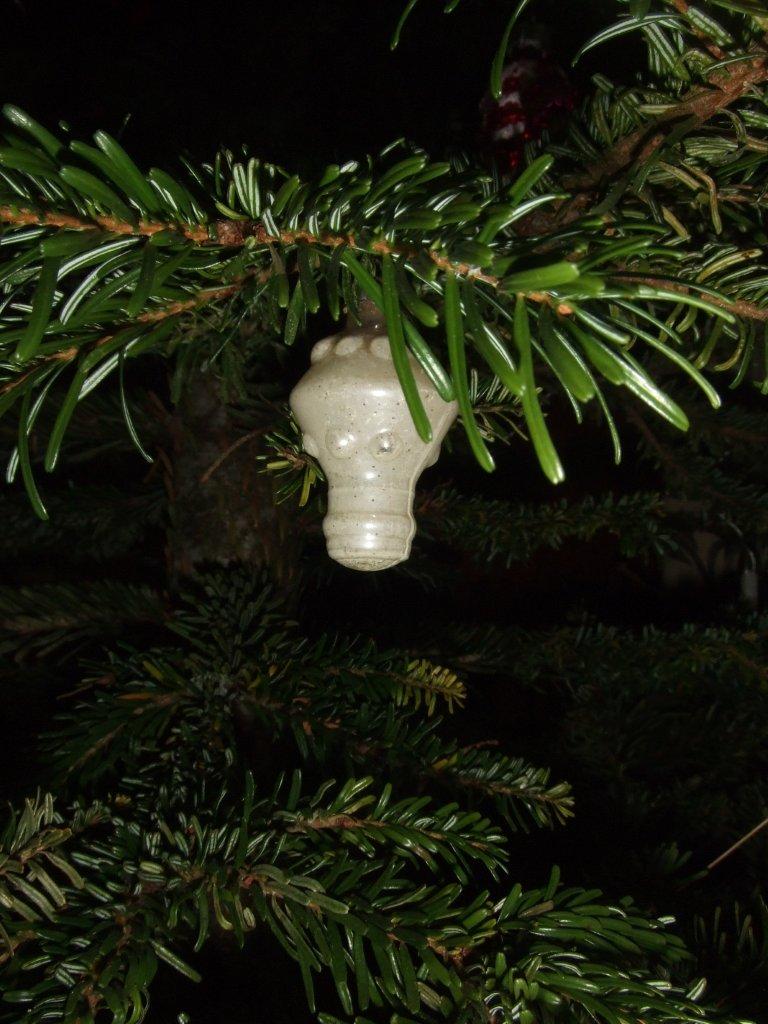
This year I will show you the oldest baubles we have: five British-made Austerity baubles from 1945. My newly married parents spent the last two years of the war in the Gold Coast (now Ghana) and then moved to smoke-stained and dispirited York, a far cry from the brightly burnished tourist town of today.   Burnished decorations were also in short supply, the Czech glass industry  all but extinguished.

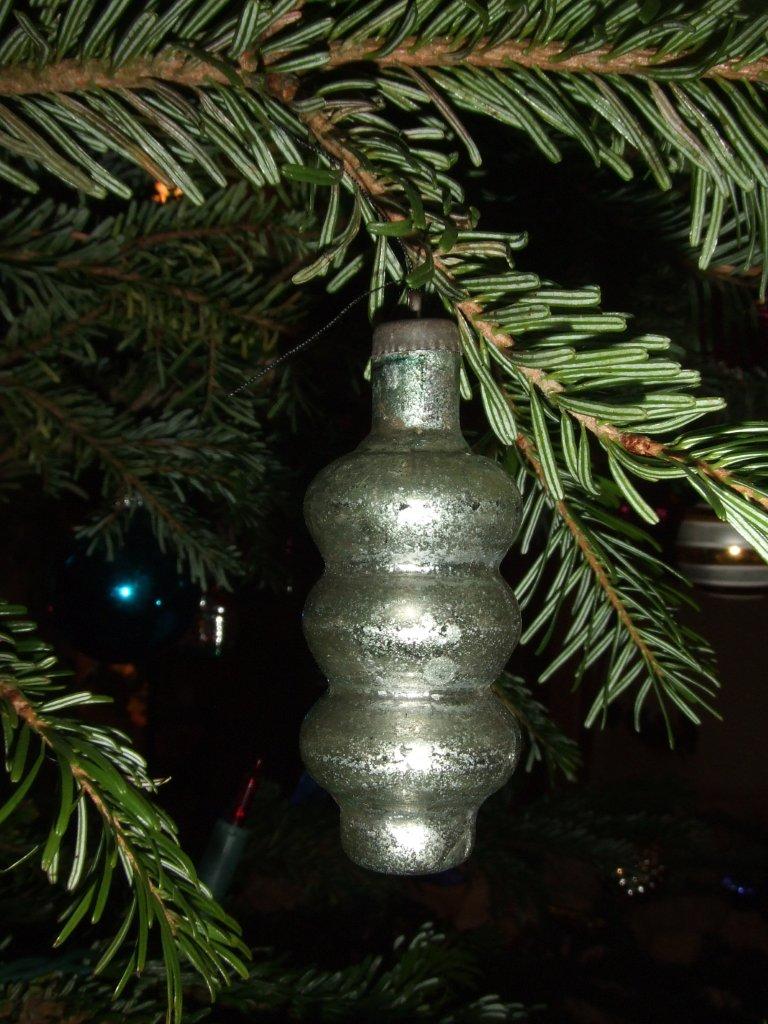
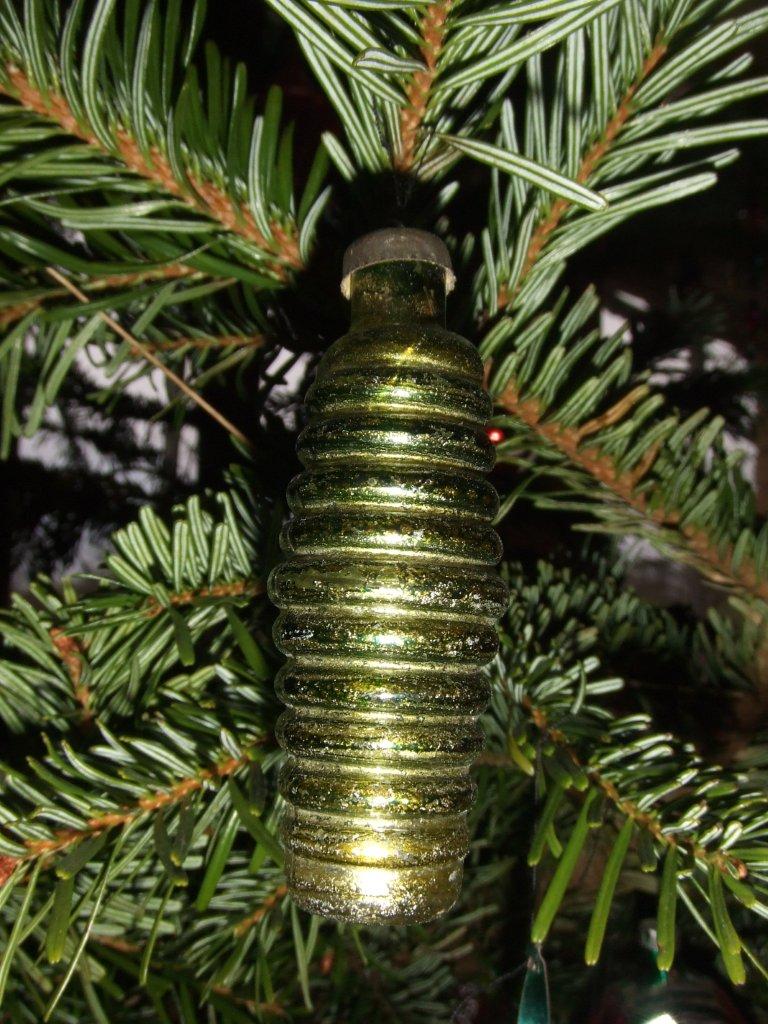
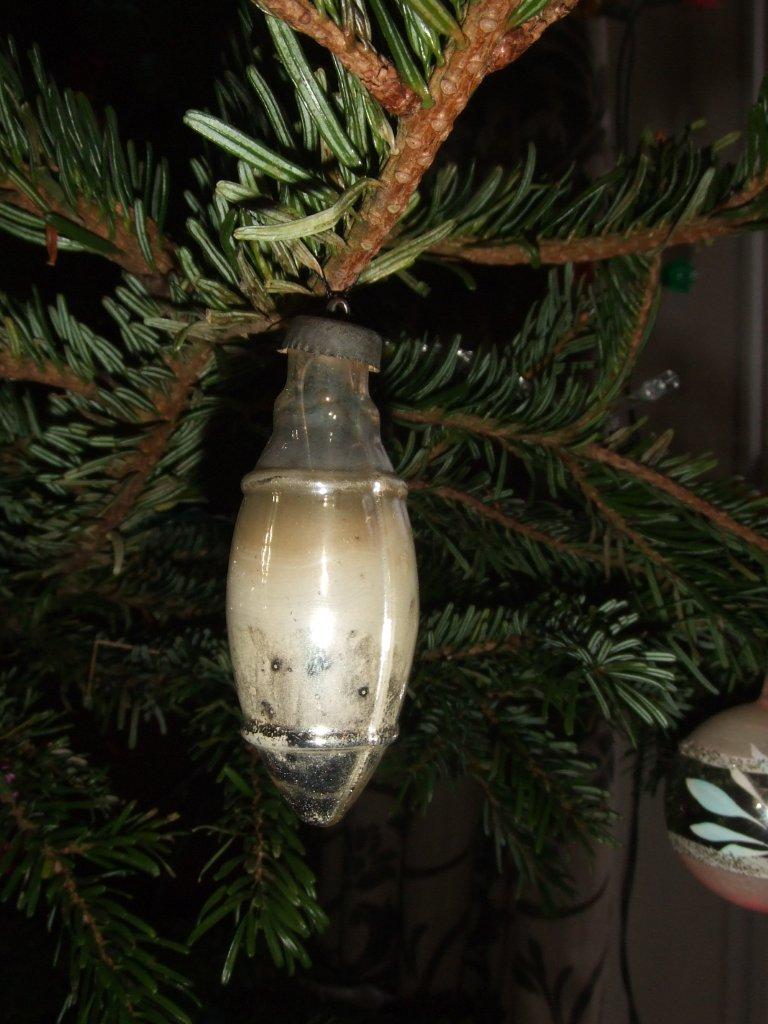
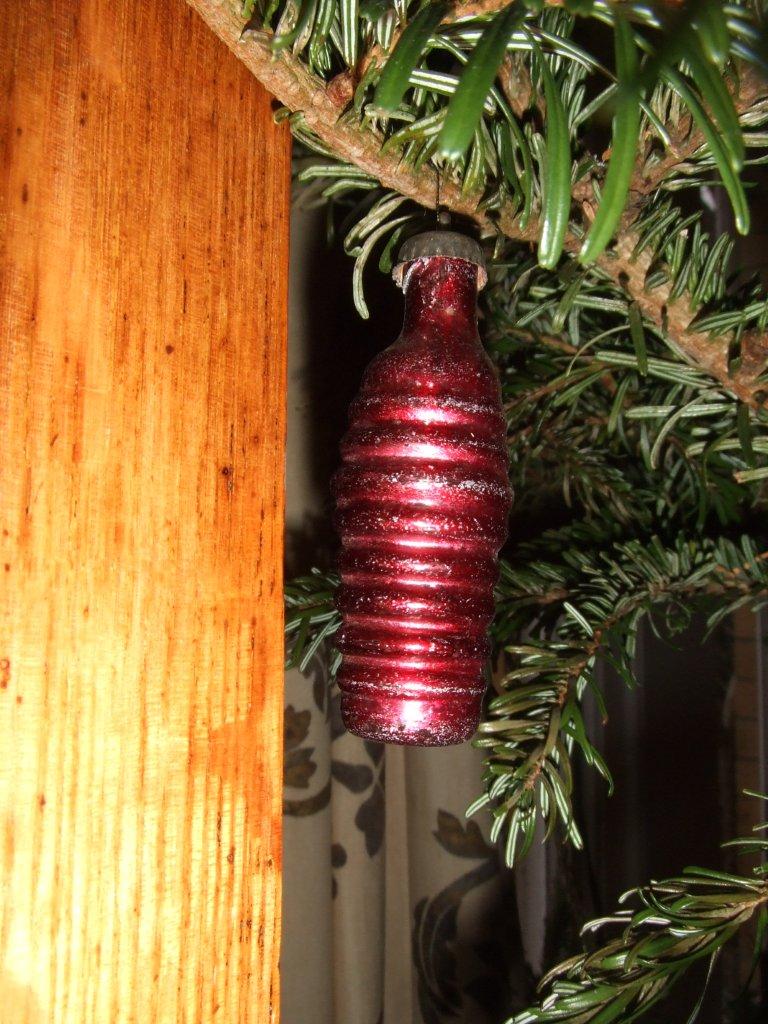
But someone in Britain had sought to fill the gap, with ornately moulded glass not seen before or since, and my mother bought a box of five.  The little caps with the spring legs which slot into the neck are far solider than in normal baubles, and with an inconveniently tiny eyelet which makes them difficult to thread.  And they are quite drab-coloured, rather than the familiar mirrored glass, one is misty blue, one red, one green.   Their opacity resembles Roman glass retrieved from the sea. Two smaller ones are mirrored silver, probably indeed made like mirrors, and like old mirrors the silvering has slipped and tarnished.   But these wartime baubles held their own as the glossier foreign goods reappeared and have always had a special place in my affections.  Those who grew up reading the Tim books by Edward Ardizzone will remember when Tim went to sea and Ginger, the cabin boy, illicitly drank of the first mate’s patent hair-growing medicine.  The blue bauble has always, for me, represented the flask of the dreaded hair tonic in the book.  And the other baubles have ridges, grooves and ornamental bosses unlike anything which has been produced since.  Neither the largest nor the brightest, these ornaments set the stage for the continuous collecting of the following years.

DSCF0777

The blue moulded bauble reminded me of Ardizzone’s hair tonic bottle.

DSCF0778

The Green glass bauble

The mirror glass baubles have not aged well

Also from 1945, showing signs of age

DSCF0776

The red bauble moulded in the same form as the green one

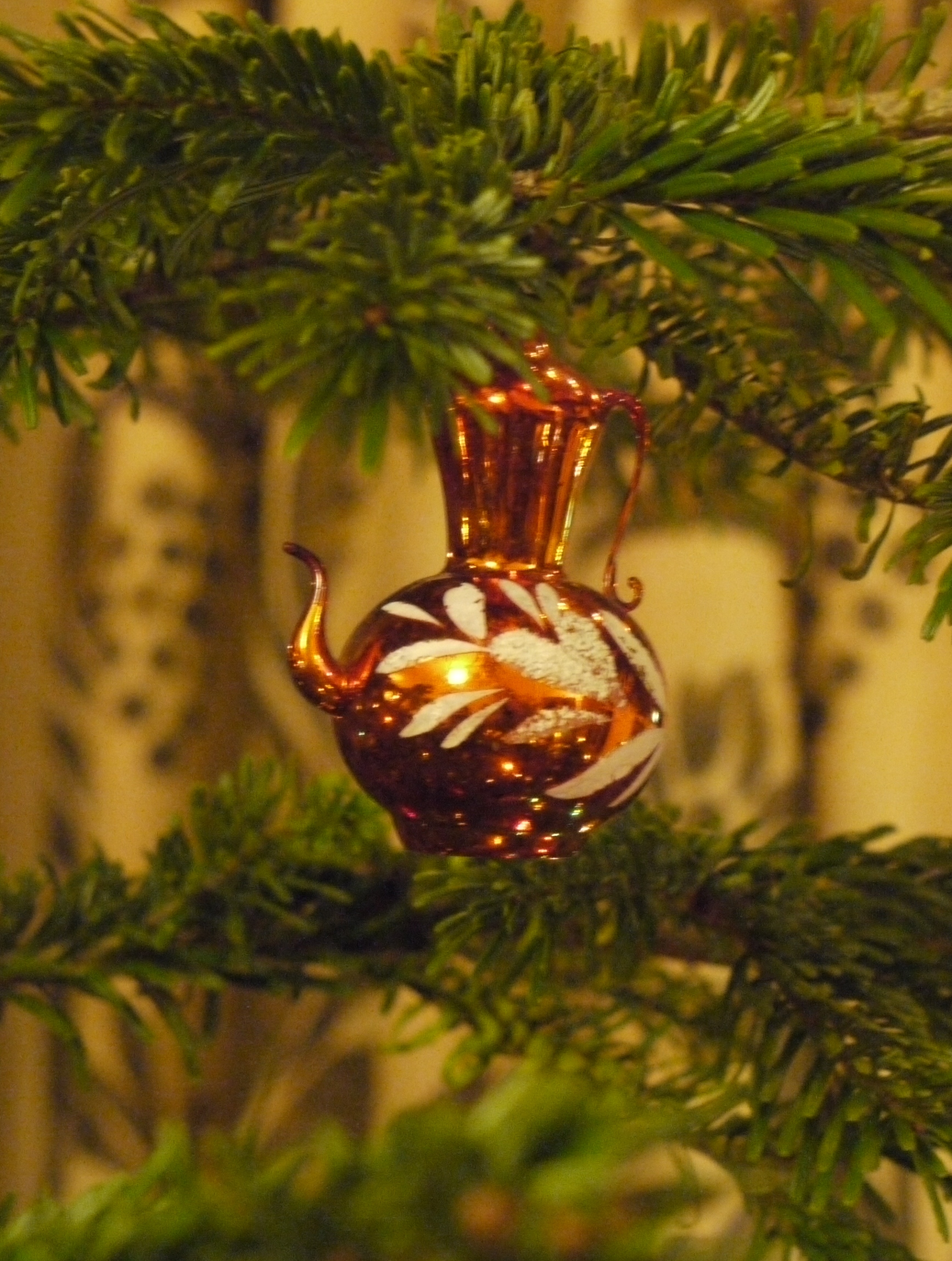
Czech glass appeared in glittering heaps and bins in the upstairs section of W.H.Smiths by the late 50s. I remember the year my mother bought a golden glass trumpet with the metal reed set in its flaring bell, which we were each allowed to blow, just once, before it was hung on the tree, and I remember the year I was allowed to select my own novelty bauble and I chose a copper coloured kettle with handle and spout, about two inches tall.  I treasure it still.

    My Copper kettle - A Czechoslovakian glass bauble from the later 1950s

My Copper kettle – A Czechoslovakian glass bauble from the later 1950s


Not enough disability in Aberystwyth?

by the Curious Scribbler

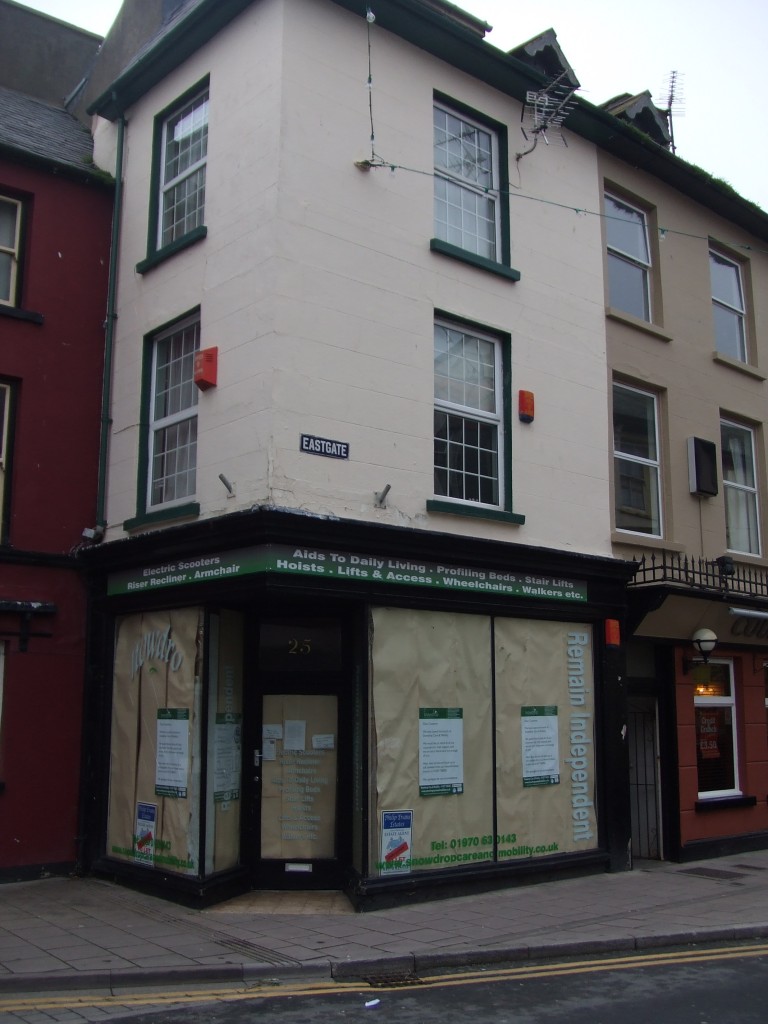
Another independent shop has closed its doors in Aberystwyth’s picturesque Eastgate Street. The windows, masked in brown paper give it a depressing  air.

Closed shop in Eastgate, Aberystwyth

The now closed Snowdrop Care and Mobility shop in Eastgate Street

However the message posted to the customers gives pause for thought, for it reads “ We would like to thank all our customers for their support and we are sorry there were not enough of you”.

Snowdrop Care and Mobility sold walking aids and wheelchairs, lift-and-recline chairs and beds, mobility scooters, ramps, stair-lifts, continence aids and extra wide footwear for swollen feet.   Not equipment many of us are eager to need. Can we conclude that Aberystwyth’s population is, in the main, ageing more healthily than the commercial predictions suggested?  I hope so.   Certainly there are plenty of the elderly out and about leading busy lives.

Those less fortunate, it is implied (and I hope there are not too many of them) will have to shuffle off to Haverforwest  ( a round trip of 125 miles).   On the other hand they may resort, as we all increasingly do, to doing their shopping on the internet.  I understand that an extensive range of this equipment can be obtained through Lloyds Pharmacy.

Customer told they were insufficiently numerous for the retailer

A reproachful notice to customers of the now-departed shop

Reflections on dementia

by The Curious Scribbler

My mother was never considered to be suffering from Alzheimer’s disease.  Indeed her death certificate (for she died, a week ago, aged 94) has a slightly farcical ring about it.  Her certified causes of death are Hypertension, Old Age and Memory Loss.  It reads as if she just forgot to go on living.   More likely vascular dementia played a part.  Abnormalities of this sort were detected in a brain scan about seven years ago, and her final years were marked by a number of TIAs (Transient ischaemic attacks) or mini strokes, from which she usually physically recovered, though there were new lapses in memory and ability.

But what is more striking than what she lost is what she retained:  an iron certainty that she was right, and that the only way of doing things was her way.  In my last blog this certainty applied to the control of the items on her overbed table and to her method of achieving quality control on her diet of chocolate buttons.

Here she is five years ago in another white-knuckle account I wrote then:

Shopping for my elderly mother: The quest for the perfect toothbrush                     13 February 2007

I have searched every chemist in town for a small-headed Maclean’s toothbrush like the worn one I have been compelled to carry around in my handbag for the last week.
Eventually I go to the dentists’ and queue to ask if they have any of these toothbrushes (this is where Mummy says they come from, – but because they are no longer on visible display she did not ask for them when she went to the dentist last week). They sell me an OralB small-headed toothbrush which is very similar to the Maclean’s one. The assistant has worked there for eight years. She is quite definite that they have never sold Maclean’s toothbrushes.

I took the toothbrush round to my mother and handed it to her.
She gazed at it and laughed merrily.  “Ha,Ha, ha, ha, ha, ha.” She chuckled.

 I couldn’t muster such a cheerful peal however hard I tried.
She drew breath and laughed again.
“What,” I asked calmly “is so funny about it?”
“Oh, I’ve never seen one like it!” she replied.

I point out its similarity to her present Maclean’s tooth brush, which I fetch from upstairs. The small head is exactly the same size. The handle has one blue flash rather than three diagonal stripes. The handle, she says is very long. She has never seen such a long toothbrush.

I hold them side by side:  once you subtract the packaging, the two toothbrushes are exactly the same length.
So now we come to the bristles. This new toothbrush has the tufts of bristles cut on a slight diagonal so that they are longer at the front. The toothbrush she has just started using has them cut square. The manky brown-stained ex-toothbrush in my handbag has alternate pairs of long and short tufts.

But I can tell, it is not, and never will be, satisfactory. I tell her that the assistant at the Dentists’ says that they never did stock Maclean’s toothbrushes. She shakes her head emphatically with a knowing grin. She knows when she is being told a whopper.

 ***********

Was this a symptom of dementia?  Or was she just being herself?


A Degree of Dementia

by The Curious Scribbler

She is awake in her chair and watching the TV.  The sound is off.  If it were on she would not hear it.  She is deaf.

On her table is a substantial stack of broken fragments of chocolate buttons.  There is also a pool of tea.  The lipstick which always props up the chocolate-smeared emery board is particularly heavily smeared with chocolate.

I tackle the problem.

“You look in a bit of a mess here,” I say.  I point to the buttons.  “Do you want these?”

“No,” she replies, “they are old ones.”

“They are only broken” I say, “You are throwing away perfectly good chocolate.”  But I collect a paper towel from the bathroom and clear up the heap of mauled chocolate.  I wash the lipstick case in warm water and return it to its place.  She seems accepting rather than grateful.

The situation is worse than I thought.  A layer of milky tea has spread across the table, soaking under the lizard from Lanzarote, the Chinese serpentine frog on a lily-pad, the birthday cards from me and from my sister-in-law.  I pick each up and wash the table with more paper towels.  A j-cloth would be handy but Health and Safety regulations in the Nursing Home determine that only disposable materials may be used for cleaning by us amateurs, the relatives.  We don’t even have the use of a drying up cloth or a washing up brush in the kitchen for fear we might spread contamination.  As a result all the personally owned mugs become rimed with tannins, brownish in their crevices.

The tea on her table derives from my mother’s obsession with placing her empty mug on its side when it is finished, or in her words “dead”.  It is not invariably completely empty when she makes this decision.

As I clean I pause to speak distinctly and slowly in her ear.  “This- happens- because- you- insist-on putting- your -mug -down-on-it’s-side.”  I say.  She hears the words.  “Possibly,” she replies, “ but I have found that it is best this way.”

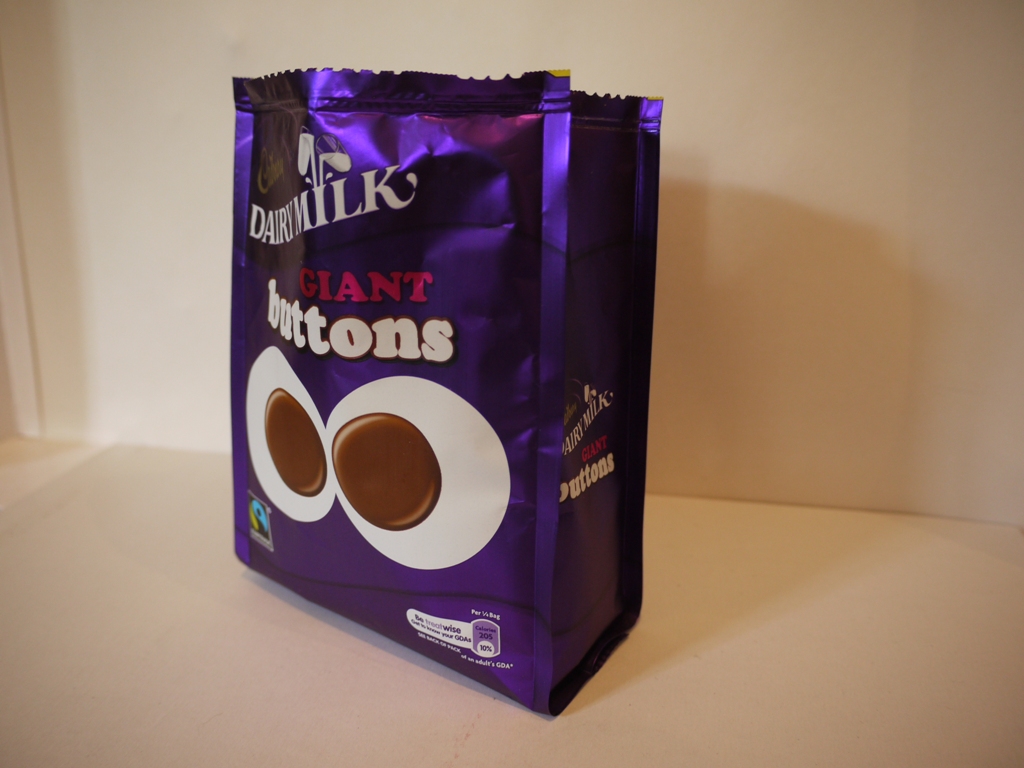
When I am done, I water the flowers, restock her mini fridge with six packets of Cadbury’s Giant Chocolate Buttons, and her cupboard with three bottles of Maple Syrup.  Dementia likes sweet flavours.   She has long taken maple syrup on her porridge. Now she demands it on her soup and pureed meals as well.  One of the nurses is pregnant, nauseous, and cannot bear to feed my mother this mixture.   She delegates lunch and supper feeding to other carers.

Poor old lady you think, unable to feed herself.  But she is able. She simply elects not to.  That is what the carers are there for.

Her room tidied, I sit down on the bed beside her.  My gorge rises.  There on the table is a new stack of nine or ten chocolate button fragments.  With her right thumbnail she is deftly prizing two fused chocolate buttons apart and discarding the pieces.  Little wonder many are stuck together.  All day she sits with the bag tucked down beside her thigh.  The buttons become warm. They stick together.  She refuses to have them placed on a plate or little bowl on her table.

“You-are-breaking-your-buttons-again.” I state clearly.

“Yes, these are not suitable ones,” she replies, “they are old.  I must throw them away.”

There is a response on the tip of my tongue.  But I confine myself to telling her that she would never have allowed a child to waste food in this way.  I, as a child, was not allowed to leave the table until I had eaten everything on my plate. “Waste is anathema to me.” she used to say.

She is unmoved by my reasoning.  I am not sure that she remembers what a child is.  I firmly suggest putting the buttons back in the fridge for a while so they will become firm again.

With dignity and force, she refuses. “No,” she says.  “ I find it works better this way.”

Cadbury's Giant Chocolate Buttons

Cadbury’s Giant Chocolate Buttons


What is a Lhasa Apso?

by The Curious Scribbler

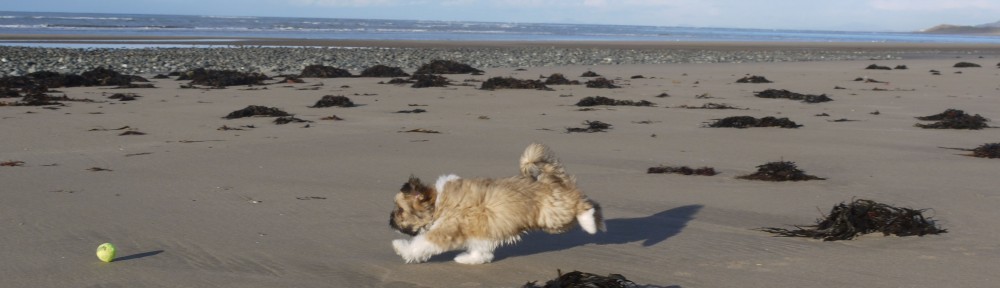
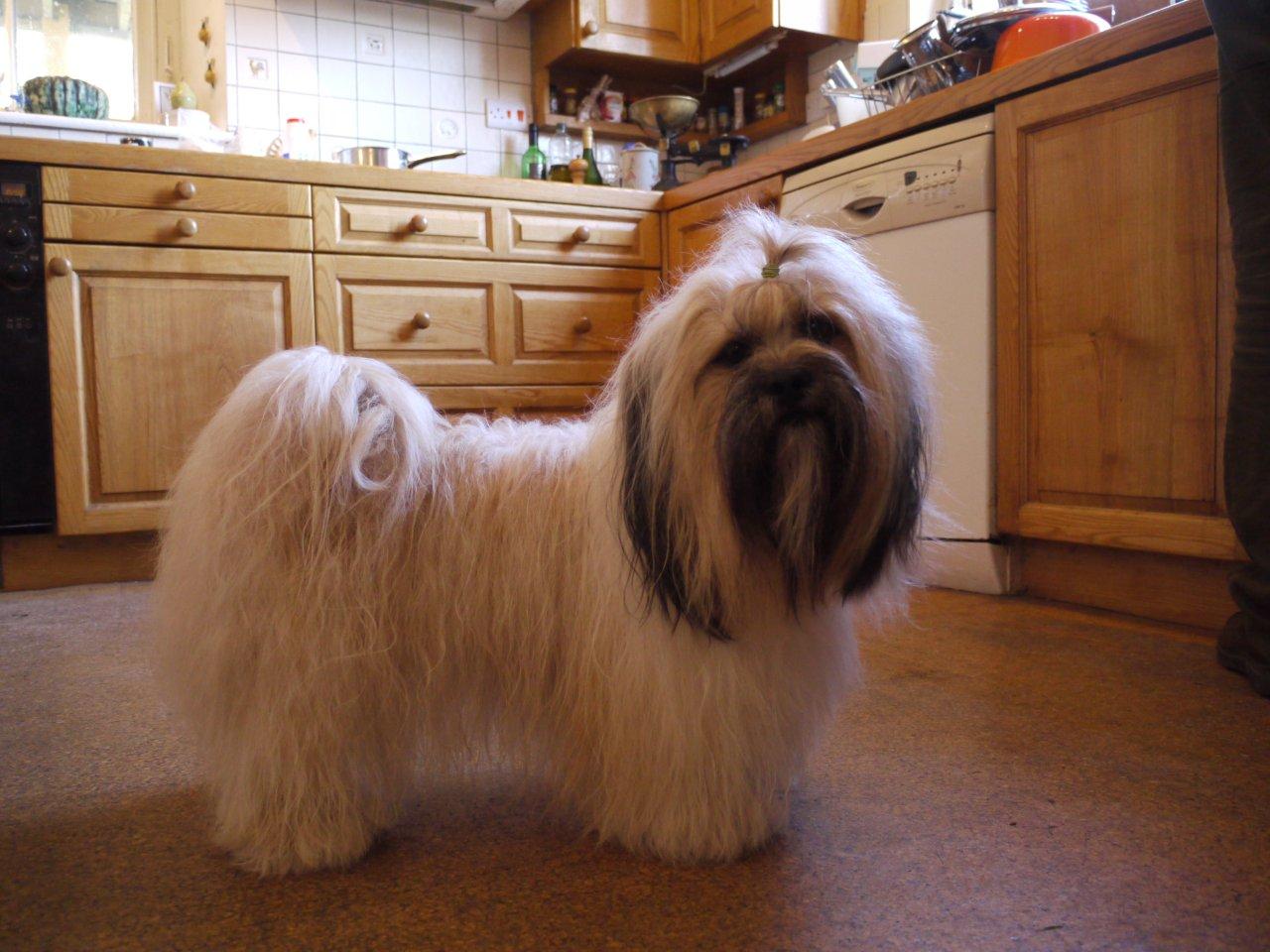
Several people have commented on the joyful puppy on the banner of this blog, so the time has come to explain. The picture is of Otto, and Otto is a Lhasa Apso.  In that picture he was three months old.

Now he is over two years and has a full long coat which almost touches the ground.  If he were a show dog it would do so, but in order to be a show dog you need to spend less time getting tangled in undergrowth and wearing off the ends of your hair and nails.

Otto, freshly groomed

Otto, freshly groomed

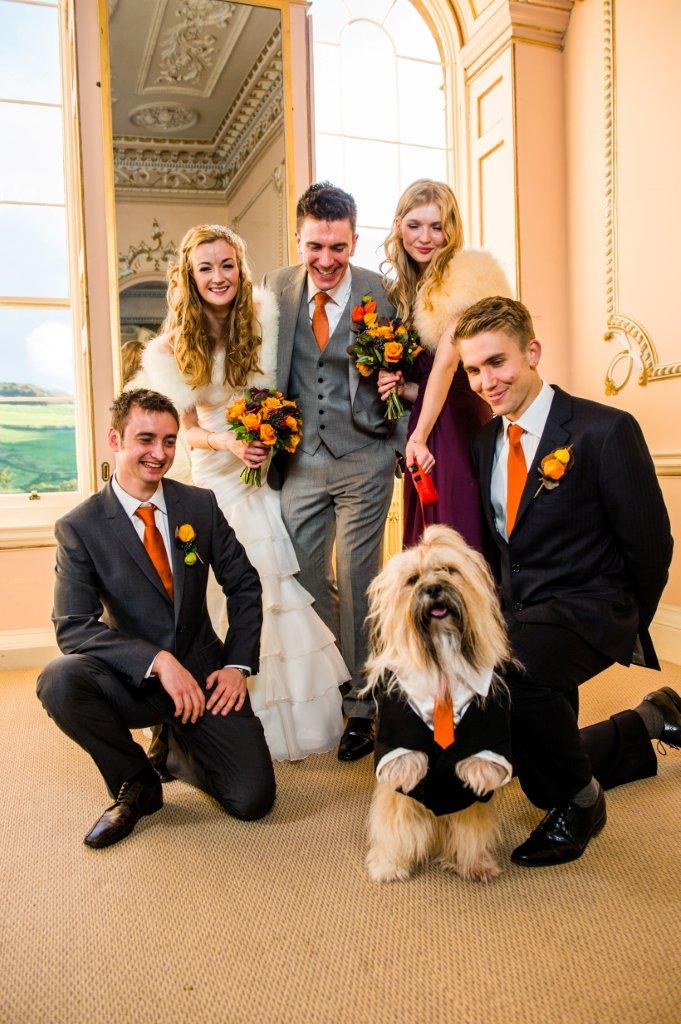
He has a bath and a major detangle about five times a year, the last bath was for the wedding, at which he wore a little costume to match the groom and the ushers and was the comic turn of the day.

Otto in costume at the wedding

Otto, a Lhasa Apso, attends a wedding

However this picture would give a false impression of the Lhasa Apso.  Inside the flowing hair he is all dog, with an enthusiasm for other dogs, deep puddles, rivers, sticky mud, sand dunes and the beach.  Lhasas are proud independent little dogs who bustle along at a trot or a gallop and appreciate a couple of miles walk a day.

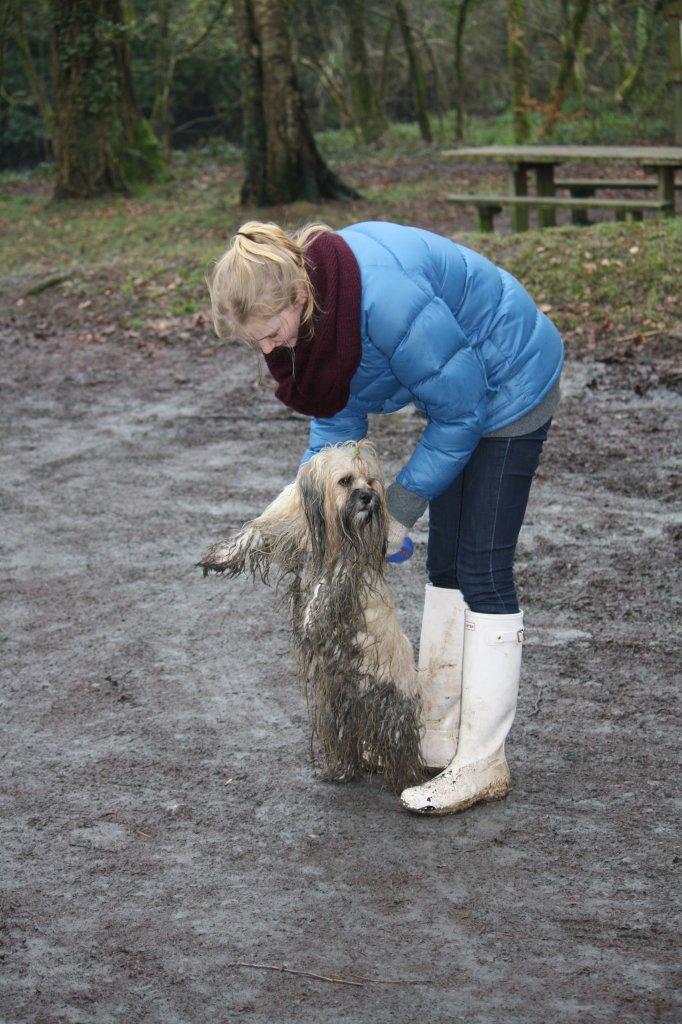
Otto in mud

Otto, A Lhasa Apso in mud

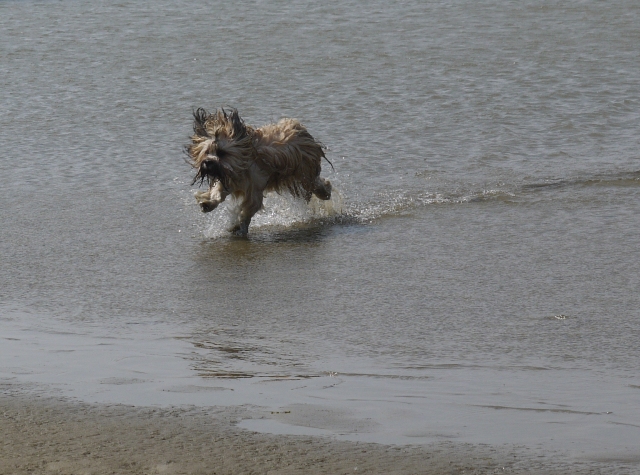
Otto, a Lhasa Apso, in the sea

Otto in the sea

Otto in the sea


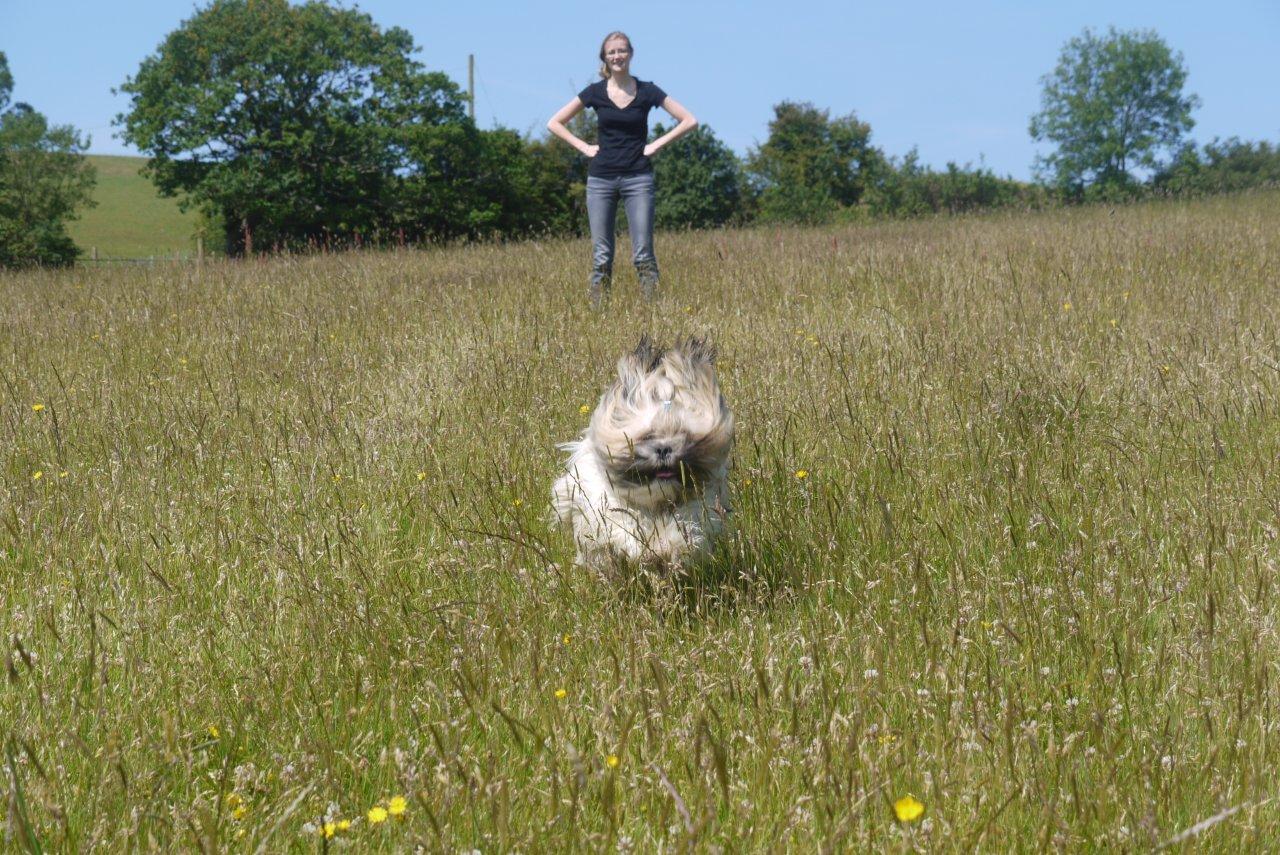
Otto, a Lhasa Apso, in hay field

Otto, a Lhasa Apso, in hay field

In the home Lhasa Apsos like to audit the visitors but having been introduced and added them to their acquaintance list they generally treat them with dignity.  They seldom bark.  For the inner circle of family members a full greeting is performed, much whirling, wriggling and standing on his hind legs waving his paws.   Lhasas are said to have their origins as Tibetan monastery dogs, perhaps as the reincarnation of monks not quite making the grade for Nirvana.   They like to sleep in an elevated bed, or indeed along the back of the sofa cushions will do.

Otto is deeply in love with his cats, Boris and Bertha.  When they were tiny kittens they hissed ferociously at him, and most downcast he would retreat a few inches and lie watching them, his chin on his big fluffy paws.  Within a week they had relented, and were rewarded with much affectionate dog licking.  We felt we should intervene as Boris became quite spikey and wet with saliva.  But when we tied up the dog to give respite from this degree of love, the kitten just marched up and demanded more.  Over a few weeks the licking abated.  When Otto feels the urge he captures a kitten, presses it to the ground and snuffles it.  When the cats choose, they lure him into wild chasing games around the house.

When I was trained many years ago in Animal Behaviour we were discouraged from naming animals anthropomorphically and taught to see their behaviours as purely adaptive mechanisms which further their survival.  Emotions were not supposed to be an animal attribute. Anyone who lives with pets soon doubts this mantra.  The dog and the cat have long contributed to the domestication of man, and have a wide repertoire of endearing behaviours of little other value.  They gain much from this co-existence, for their appeal to humans has ensured their food and comfort for millennia.  Otto, Boris and Bertha have welded themselves into a little multi-species family, in which there is no friction and a great deal of warmth.  When we sit down at the end of the day they expand the group to embrace us too.


Bring in the bulldozer!

By The Curious Scribbler

There is a smallholding for sale not far from Aberystwyth near Lledrod.  With customary overstatement the local agent, Jim Raw Rees begins their particulars “Rarely does such an opportunity come to the market..”     The price has been reduced to £150,000 for 12 acres, a bungalow and outbuildings.

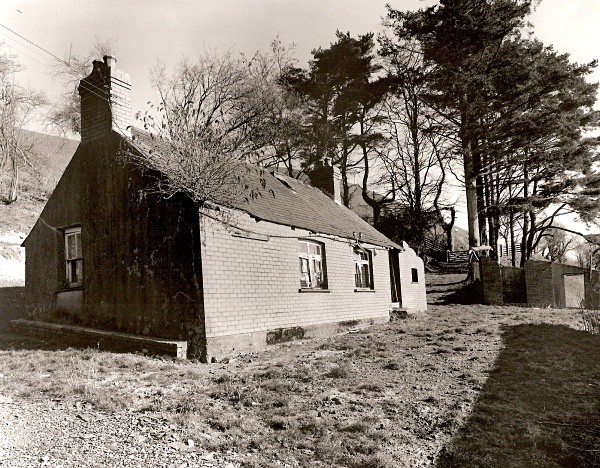
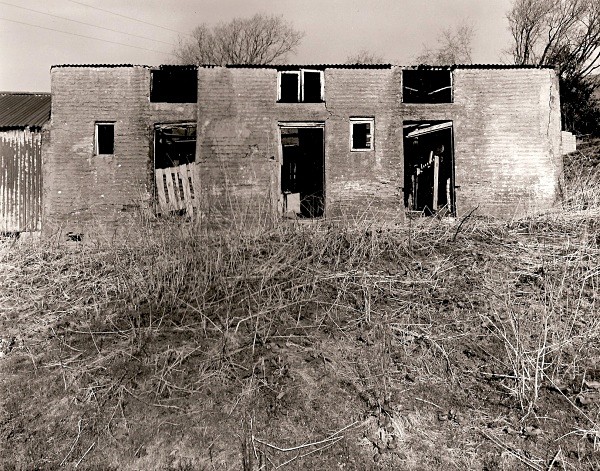
But what buildings!  If there is something that Ceredigion has excelled at in the 20th century it is mean rural dwellings.  Set on a south facing slope is a small red brick bungalow of repellent appearance, not that old, just small and ugly, but with planning permission to become less so.  Paul White, who has devoted much of his life to photographing ruins in Wales, both grand mansions and modest farms and outbuildings has been along to take these evocative photos in black and white.   He suggests it looks like a railway cottage escaped from its natural habitat.

The derelict red brick bungalow at Lluest Newydd, near Lledrod
Copyright Paul White

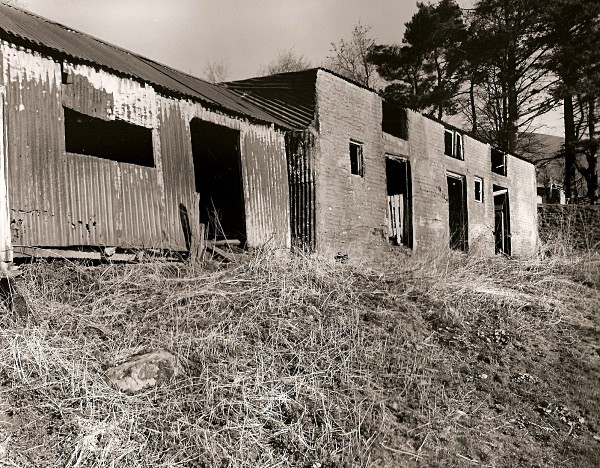
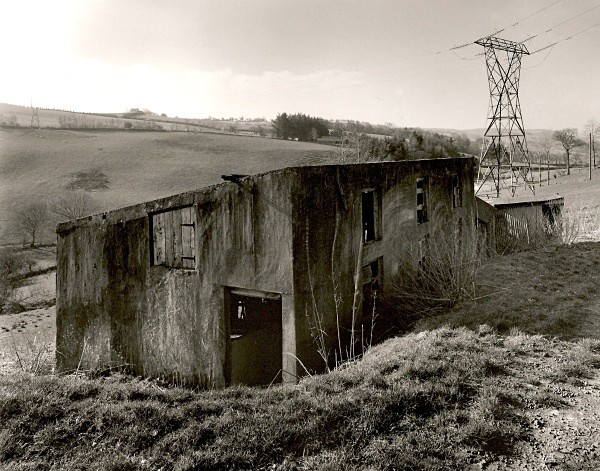
Blocking the view, or more poetically  “in the eye of the sun” to quote Raw Rees, is a range of even stranger out-buildings – part masonry, part corrugated iron.   Why those three tall doorways and above each the domestic style upstairs window? Why does the roof sit directly upon these windows?  Is this one of those abortive self-build projects which ran into despair?

If the whole site were razed to the ground the south facing hillside would warm the cockles of a horse or goat owner, or make a happy field for a great assortment of poultry.  And today far more attractive modern vernacular buildings are being put up for more enlightened owners.

Paul’s pictures distil what is ugliest about Lluest Newydd.  It has a place in history, but let us hope is soon loses its present foothold on the hillside.  According to Zoopla it has received 500 hits in the last month.  Surely salvation, notwithstanding our almost incessant rain, is in sight?

Outbuilding at Lluest Newydd

Outbuilding at Lluest Newydd


Pictures copyright Paul White see http://www.welshruins.co.uk