Launching my book in Rhydyfelin

by The Curious Scribbler,

I wrote in January and February this year about my artist great-aunts, Jet and Aeta Jardine, whose work was due to be exhibited at the Reid Gallery, Glasgow School of Art in September 2026.  The exhibition was, unfortunately, postponed, and will now be held from 25 September to 6 November 2027.

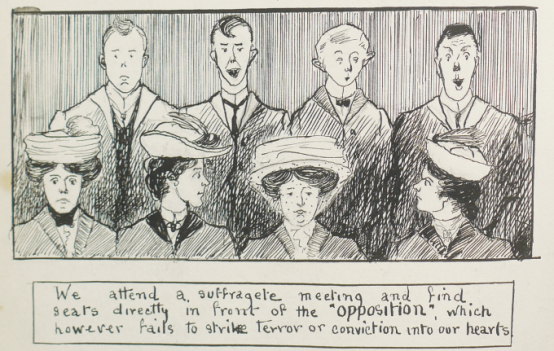
Meanwhile though, I and Y Lolfa have published a book, A year in Glasgow 1908, which reproduces Aeta Jardine’s  sketch diary describing her life in 1908.  At the time she was resident in Kelvinside, Glasgow with her mother, her elder sister Jet, and her younger brother Nigel.  Using a bound book of paper samples from the firm of Alex Pirie and Sons Ltd, she created more than sixty studies of incidents in their lives that year. The sisters studied French at the Berlitz school in Sauchiehall Street, art at the Glasgow School of Art, enjoyed entertainments at the theatre, circus and music hall, holidayed on the windy coast at Findhorn, and went on a visit to Paris.  They swam at the Arlington baths and attended gymnastic classes.  Her acute eye and wry captions paint an engaging picture of her life, her family and the people she meets.  Young men also pass under her critical gaze:  French tutors, fellow students, her brothers’ friends, or the youths attending a Suffragette meeting.
Both sisters went on to become lifelong watercolour artists who, though never famous, regularly exhibited and sold their work.  They never married and lived in Scotland with their mother until she died aged seventy. Soon afterwards they  moved to London, and exhibited in the Royal Academy Summer Exhibitions.  But some of the youthful joie de vivre had disappeared by then.     Jet developed great skill in still life studies and a unique style in slightly judgemental pictures of people while Aeta concentrated on landscape scenes. ( see January and February blogs).

I produced the book in order that it could be sold at the Reid Gallery exhibition when the original sketch book was to be displayed, open at a single page, in a glass case.  That will now take place next year, but in the meantime there will be an Aberystwyth launch event, on Tuesday 27 October 5.30-7pm.  The venue will be Gosen Chapel, Rhydyfelin, where the vestry has been recently refurbished as a ballet studio.

There has been much social change in the 120 years since my great aunts were young women in the second city of empire.  Back then, Gosen Chapel was just forty years old, and had a large nonconformist congregation.  It is happy circumstance that the chapel has found a new life in the 21st century not as a carpet warehouse or house conversion, but as an elegant hall mainly devoted to dance and exercise.
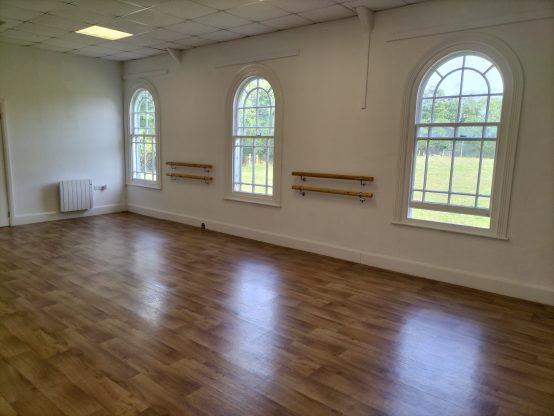
The restored vestry at Capel Gosen, Rhydyfelin where the book launch will be held.


Would you call these Goblins?

by The Curious Scribbler

Many children in the early twentieth century grew up hoping to glimpse a little magic on their country walks, imagination fuelled by picture books and stories offering an assortment of fairies, dwarves, leprechauns and other little people.  Fairy fever burgeoned in 1920 when Sir Arthur Conan Doyle  published two photographs of the Cottingley Fairies in the Christmas Edition of The Strand Magazine.  These early photographic fakes were the work of nineteen year old Elsie Wright, who had utilized her photographer father’s plate camera and her pretty little cousin to imaginative effect.   Such fairy fever also led to the work of Cicely Mary Barker, whose first book Flower Fairies of the Spring was published in 1923.  It and the following seven volumes entranced so many little girls.   Cicely’s immaculate watercolour paintings each paired a botanically exquisite plant portrait with a beautiful child, costumed in clothing wrought out of  components of the flower. There were both boy and girl fairies, and it is said they were modelled on the children who were sent to her sister’s kindergarten.

Flower fairies have an enduring and entirely wholesome appeal.  When my daughters were growing up in the 1980s they were reinvented as a set of seven-inch costume dolls, less extravagantly leggy than Barbie, wearing clothing representing Briar Rose, Bluebell, Daffodil and so on.

Another early twentieth century artist, Jet S.Jardine, also placed her fairy people in the English (or perhaps the Scottish) countryside, but their world was a far more threatening place.  These little naked creatures shelter from the rain under mushrooms, are swept up in the wind, or cower at the hoot of an owl.

Patience under a Mushroom by J.S.Jardine

Quite Lost by J.S. Jardine

Dragonfly by JS Jardine

The nearest they come to comfort is when they play with caterpillars or shelter in a birds nest, but even here we are not certain whether the bird is about to evict them.

Full House by J.S Jardine

Jet Jardine called her creatures goblins – but they are too weak and vulnerable for most people’s idea of a goblin!  Goblins are defined  as malevolent  and hairy and usually around one foot tall.  Not the sort of creature to flinch from a spider on a windblown sycamore leaf.  When one of these pictures appeared on the market, Christie’s saleroom listed it as a Pixie, but I think pixies are generally mischievous and clothed. I would welcome suggestions as to where Jet’s creations fit in a classification of mythical humanoids.

Jet and her younger sister Aeta both studied at the Glasgow School of Art and exhibited at the Royal Scottish Academy, the Royal Watercolour Society and at Royal Academy Summer Exhibitions.  Almost completely forgotten today, they  lived together all their lives, in Scotland till 1920, and in London thereafter.   I hope their profile will rise again this autumn, when  a retrospective of their work will be exhibited in the Reid Gallery of the Glasgow School of Art.  These artists were my great aunts, and I plan to showcase their work, which spanned a number of different genres, by posting some more of their pictures in the next few blogs.