
A cold eye on motherhood

By The Curious Scribbler

When not inventing her remarkable goblins, my great-aunt Jet S Jardine painted watercolours in a number of other genres: meticulous still life paintings of flowers in her studio, and plein air landscape scenes in many parts of the British Isles.  She also drew people.   She turned particularly unsentimental  eye on motherhood, as the following pictures show. How very seldom does one see a picture of a furiously screaming toddler, arching its back in the arms of its suffering mother or nanny?
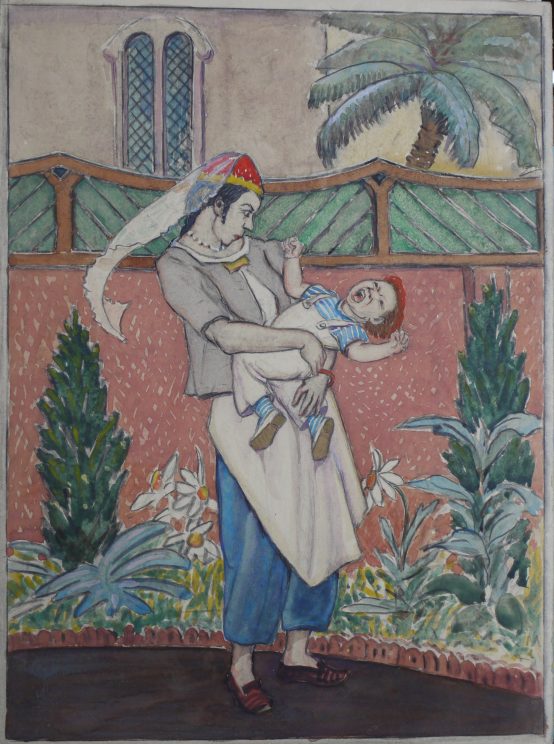
Artwork by Jet S Jardine

In another picture a lady in a green jacket holds a scarcely clad baby at arms length, viewing it with contemplative distaste.  One feels she will be glad to relinquish it to other hands.
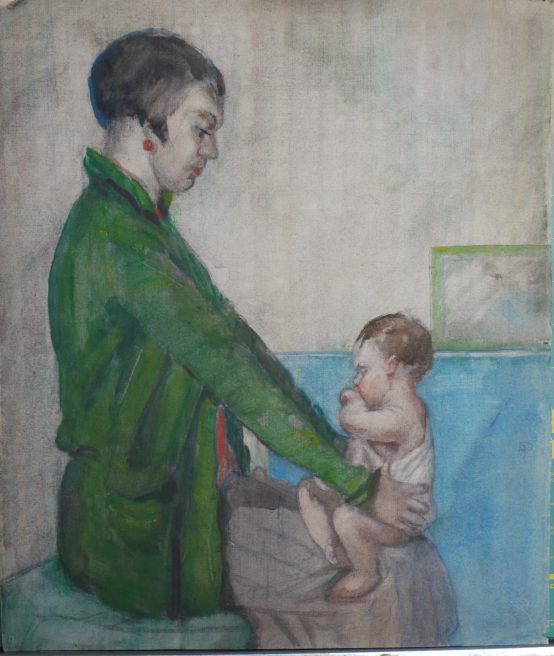
Artwork by Jet S Jardine

Jet Jardine was born a Victorian in 1881  and studied for at least seven years at the Glasgow School of Art.  In 1920 she and her sister Aeta moved to London where they lived frugally through a period of great social change.  It was in London that she painted a picture entitled ‘Thoroughly Modern Ma’.  The young mother slouches in trousers, smokes a cigarette, and  pushes her child in a small bassinette, quite unlike the grand Silver Cross prams of establishment babies.  Even the cat on the fence looks appalled.
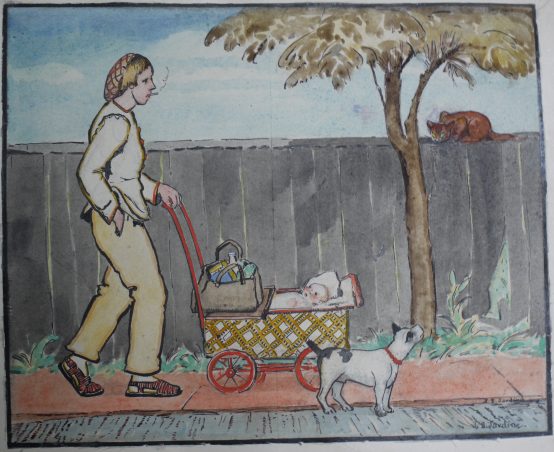
Thoroughly Modern Ma
by J S Jardine

Jet’s younger sister Aeta J Jardine also painted all her lifetime, and sold many beautifully composed landscape views.  As  a young woman she drew people, but with a far gentler perspective.  A prolonged stay in Trinidad, West Indies with their brother Warburton’s family in 1909 yielded a sketchbook replete with her drawings of family life.
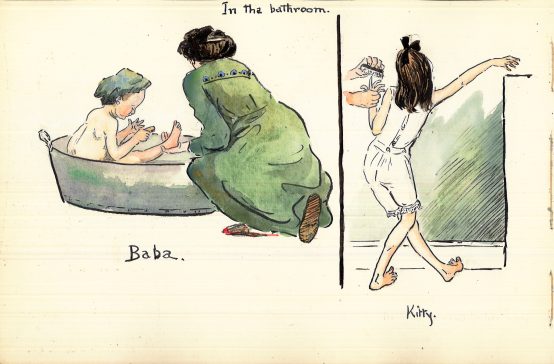
1908 sketch by Aeta J Jardine
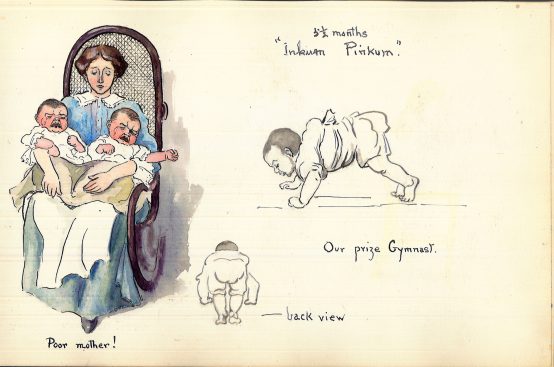
1908 sketch by Aeta J Jardine

Aeta humorously depicted her sister’s detachment when on babysitting duties for her young nephews, a role which she designated ” very unsuitable”.
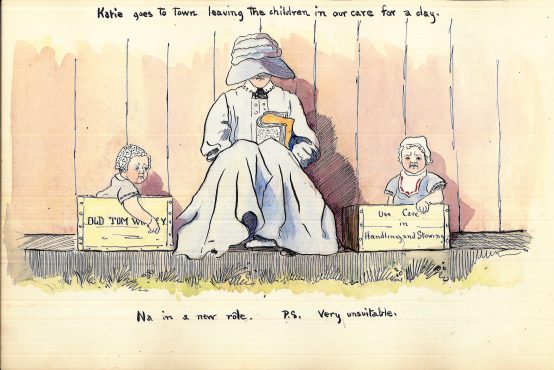
1908 sketch by Aeta J Jardine

Neither Jet or Aeta ever married and I suspect that the twin boy babies drawn by Aeta were later mutated into Jet’s goblins.  (see previous blog) Jet developed her social commentary genre of paintings during their years in London while Aeta concentrated of landscapes and never repeated the style of her family sketch book in later life.  The sisters died in Brighton in the 1960s.


Would you call these Goblins?

by The Curious Scribbler

Many children in the early twentieth century grew up hoping to glimpse a little magic on their country walks, imagination fuelled by picture books and stories offering an assortment of fairies, dwarves, leprechauns and other little people.  Fairy fever burgeoned in 1920 when Sir Arthur Conan Doyle  published two photographs of the Cottingley Fairies in the Christmas Edition of The Strand Magazine.  These early photographic fakes were the work of nineteen year old Elsie Wright, who had utilized her photographer father’s plate camera and her pretty little cousin to imaginative effect.   Such fairy fever also led to the work of Cicely Mary Barker, whose first book Flower Fairies of the Spring was published in 1923.  It and the following seven volumes entranced so many little girls.   Cicely’s immaculate watercolour paintings each paired a botanically exquisite plant portrait with a beautiful child, costumed in clothing wrought out of  components of the flower. There were both boy and girl fairies, and it is said they were modelled on the children who were sent to her sister’s kindergarten.

Flower fairies have an enduring and entirely wholesome appeal.  When my daughters were growing up in the 1980s they were reinvented as a set of seven-inch costume dolls, less extravagantly leggy than Barbie, wearing clothing representing Briar Rose, Bluebell, Daffodil and so on.

Another early twentieth century artist, Jet S.Jardine, also placed her fairy people in the English (or perhaps the Scottish) countryside, but their world was a far more threatening place.  These little naked creatures shelter from the rain under mushrooms, are swept up in the wind, or cower at the hoot of an owl.

Patience under a Mushroom by J.S.Jardine

Quite Lost by J.S. Jardine

Dragonfly by JS Jardine

The nearest they come to comfort is when they play with caterpillars or shelter in a birds nest, but even here we are not certain whether the bird is about to evict them.

Full House by J.S Jardine

Jet Jardine called her creatures goblins – but they are too weak and vulnerable for most people’s idea of a goblin!  Goblins are defined  as malevolent  and hairy and usually around one foot tall.  Not the sort of creature to flinch from a spider on a windblown sycamore leaf.  When one of these pictures appeared on the market, Christie’s saleroom listed it as a Pixie, but I think pixies are generally mischievous and clothed. I would welcome suggestions as to where Jet’s creations fit in a classification of mythical humanoids.

Jet and her younger sister Aeta both studied at the Glasgow School of Art and exhibited at the Royal Scottish Academy, the Royal Watercolour Society and at Royal Academy Summer Exhibitions.  Almost completely forgotten today, they  lived together all their lives, in Scotland till 1920, and in London thereafter.   I hope their profile will rise again this autumn, when  a retrospective of their work will be exhibited in the Reid Gallery of the Glasgow School of Art.  These artists were my great aunts, and I plan to showcase their work, which spanned a number of different genres, by posting some more of their pictures in the next few blogs.