by The Curious Scribbler,
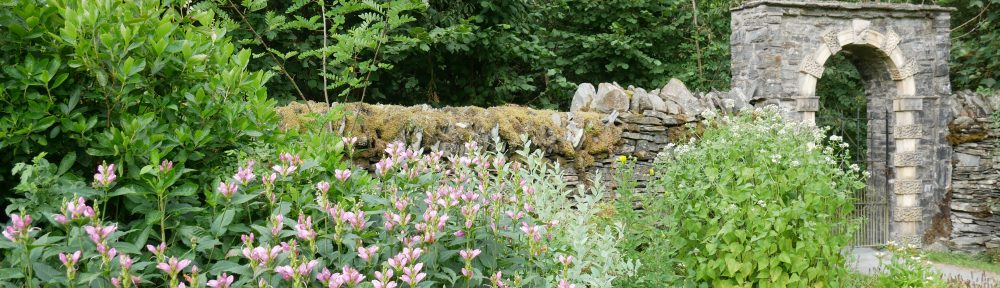
I volunteer garden at Hafod, in Mrs Johnes’ garden. Back in 2008 the garden was scarcely recognizable, lost in a mature Sitka Spruce plantation and bisected by the forest road. Eventually the Forestry Commission was persuaded, by Peter White, then Head of the Royal Commission for Historic Monuments in Wales, to re-route the road, and the subsequent restoration was carried out by the Hafod Trust. The original circuit path was reinstated and the gaps in the wall rebuilt. The borders were replanted with historically appropriate plants, mainly from Europe and the Eastern seaboard of North America. When Mrs Johnes was collecting plants for her garden in the late Eighteenth Century, none of the colourful Chinese and Japanese shrubs we take for granted had yet reached British horticulture, and the west coast of North America was yet to be a source of garden plants.
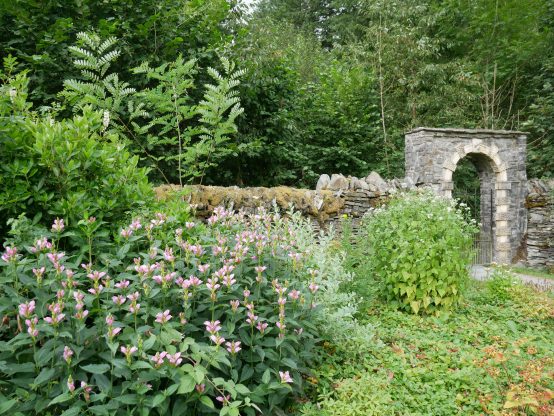
Chelone obliqua, Zenobia pulverulenta and Ageratina altissima in Mrs Johnes’ Garden in 2022
Mostly my duties are weeding. The garden is never dug and the plan is to maintain continuous cover, with shrubs, large perennials, and a spreading carpet of mat-forming plants: London Pride, Bugle, alpine strawberries, Bugle, Creeping Jenny. Other opportunists need to be removed: Hairy Bittercress sends explosive seeds far across the border, Wood Avens, Figwort and Creeping Buttercup try to spread through the strawberries, and bracken, bramble and rose bay willowherb readily invade from the wild beyond the wall.
In summer, big blocks of colour come from Doronicums, Inula, Helianthus, Lysimachia, Oenothera, Amsonia, Geranium macrorrhizum, and Chelone. But the Red Turtlehead (Chelone obliqua) is under attack. For several summers, a large quantity of this plant has been cut down and removed, leaving the snipped off stems protruding from the ground. One clump has now disappeared and the other block has a bare patch within it, about a square metre in size. This exposes bare earth which will be colonized with weeds. The weak regrowth does not flower.
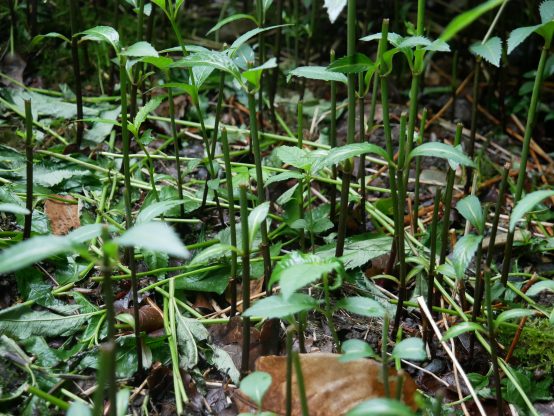
Snipped and removed
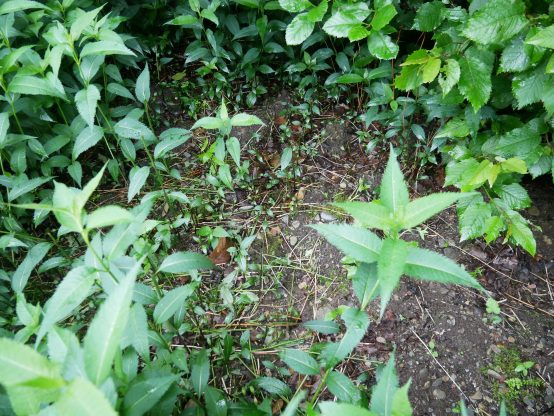
Presumably this is the work of a herbal medicine enthusiast. The leaves and stems were used in North American traditional medicine to address liver and intestinal problems. The bitter tea was used to expel parasitic worms. The repeat offender seems to need a great quantity of the plant to alleviate their symptoms. Could they not ask for a root and grow it themselves, rather than purloin the beauty of a public garden?
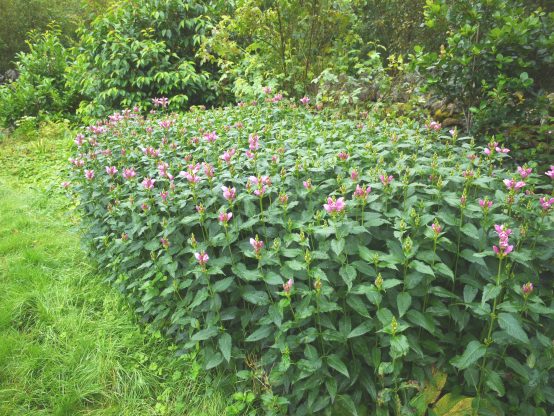
The Red Turtlehead flourishing in 2019 before the thief discovered it.
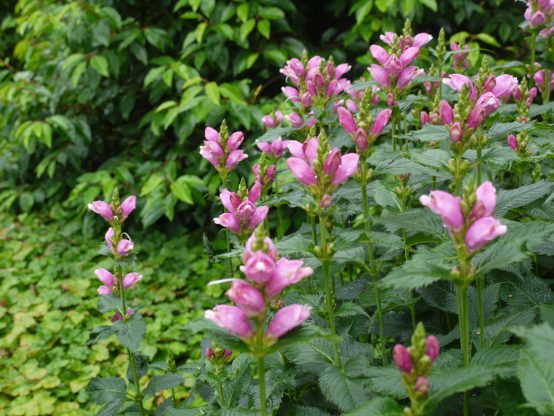
Chelone obliqua, the flower shape somewhat resembles a turtle’s head.
You may be familiar with this article about Hafod : https://whgt.wales/documents/bulletin/bulletinwinter1993.pdf
I have been trying to establish for many years if the John Paynter mentioned in the article is an ancestor of mine, perhaps belonging to my Paynter family originally from Cornwall but later established in Wales. Although this article suggests he did a great deal of good at Hafod and was fond of the place, I have read other accounts which portray him as something of a villain – so I rather hope we’re not related! (Ann Roberts, nee Paynter)
I’m afraid I don’t know more about John Paynter than what was written by John Borron in the article you refer to.